
The motor is usually the first specification people look at when buying a treadmill online. Then comes the confusing part: AC motor, DC motor, peak HP, continuous HP, brushless motor. A treadmill can suddenly feel more like a technical purchase than fitness equipment. But the choice between an AC and DC motor is actually easier when you look at how you plan to use the treadmill. For most home users, a good DC treadmill is more than enough. AC motors become more attractive when the treadmill will handle longer sessions, multiple users or heavier training. So, which one should you buy?
AC vs DC Treadmill: The Quick Difference
The simplest way to look at it is this:
| Feature | DC Motor Treadmill | AC Motor Treadmill |
| Best suited for | Home use | Heavy home or commercial use |
| Noise | Generally quieter | Can be louder |
| Typical size | Compact to medium | Larger and heavier |
| Continuous use | Better for normal home sessions | Better for extended use |
| Multiple users | Occasional family use | Better for frequent shared use |
| Price | Usually more affordable | Usually more expensive |
| Maintenance | Suitable for regular home use | Designed for heavier workloads |
| Best for | Walking, jogging and regular running | Long sessions, serious running and gym use |
PowerMax itself notes that DC motors are quieter and consume less power, while AC motors are designed for continuous operation. For typical home sessions, DC can be a practical choice.
What Is a DC Motor Treadmill?
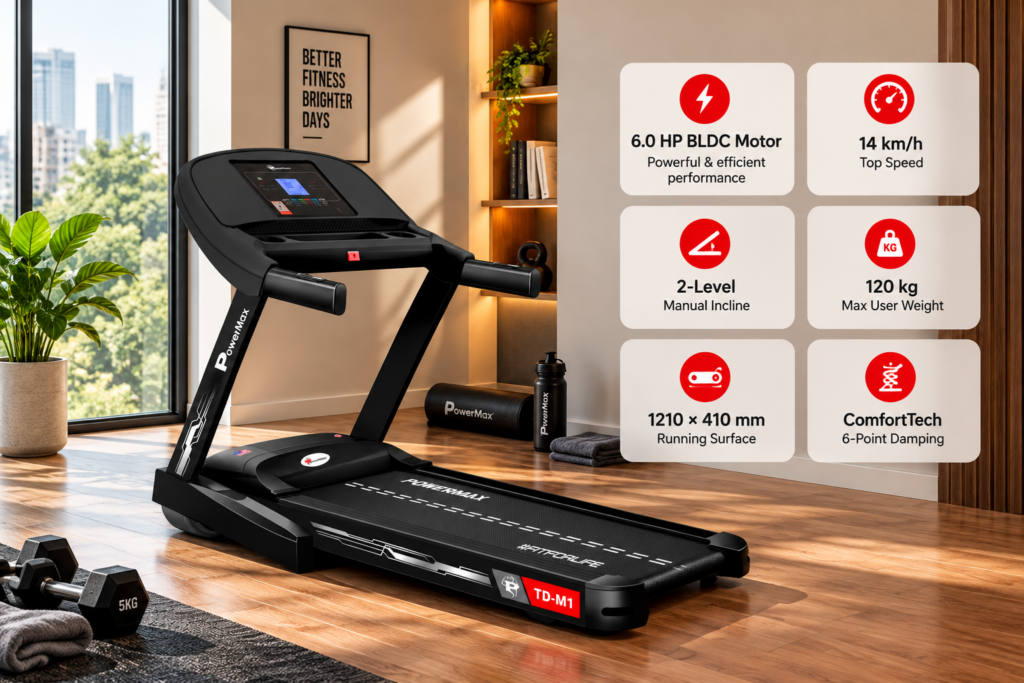
A Treadmill DC Motor is commonly found in home-use treadmills. It works particularly well for the kind of workout most people actually do at home: walking after work, a 30-minute jog before breakfast or a few kilometres while catching up on a show. Another advantage is noise. If your treadmill is going into an apartment or bedroom, a quieter motor can make the experience much easier to live with. That is one reason DC treadmills remain popular across the Treadmill For Home category. For example, if you’re buying specifically for home use, the PowerMax UrbanTrek TD-M1 is another example worth looking at. It uses a 6.0HP HiTorque BLDC motor and reaches speeds of up to 14 km/h, with a 1210 × 410 mm running surface and 2-level manual incline. It also includes a ComfortTech 6-point damping system, foldable design, Bluetooth connectivity and 12 preset workout programs.
When Does an AC Motor Treadmill Make More Sense?
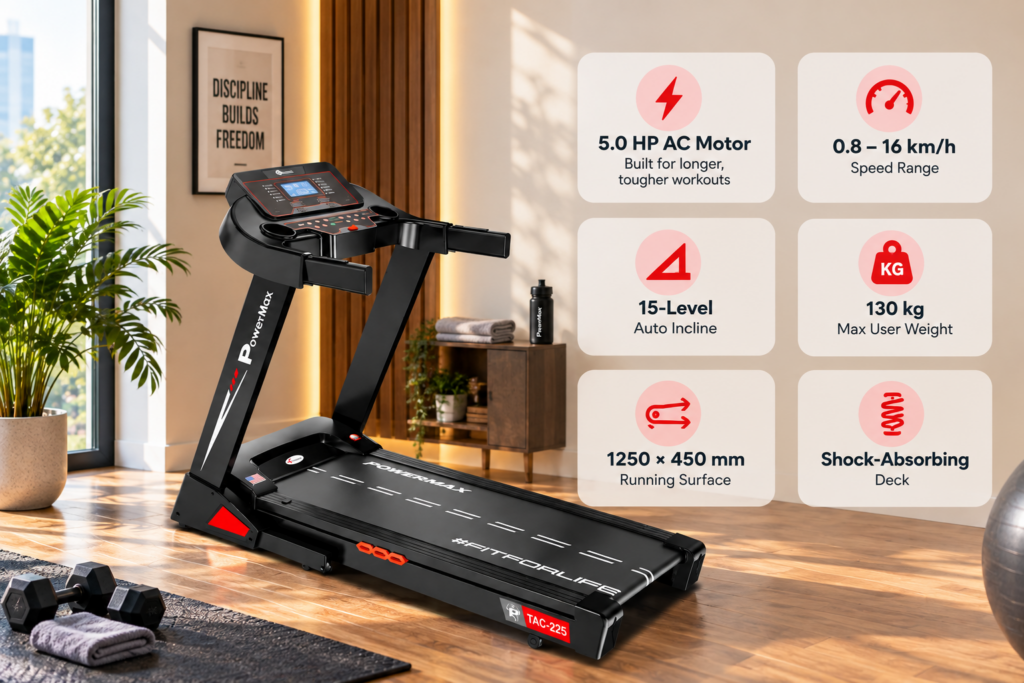
An AC Motor Treadmill starts making more sense when your treadmill is going to work harder. Think about a family where two or three people use the machine every day. Or a serious runner who regularly does long sessions. Or a small professional gym where the treadmill may be running repeatedly throughout the day. AC motors are designed for sustained workloads and are commonly used in commercial and semi-commercial treadmills. If you’re considering an AC Motor Treadmill for more demanding home workouts, the PowerMax TAC-225 is a good example of what you get when you move into a higher-performance setup. It uses a 5.0 HP AC motor, supports users up to 130 kg and offers speeds from 0.8-16 km/h. Its 1250 × 450 mm running surface and 15-level auto incline also make it better suited to longer and more varied running sessions. The bigger running surface and higher speed range also matter here. Motor type shouldn’t be considered separately from the rest of the treadmill.
AC vs DC: Which One Is Better for Home Use?
This is where treadmill buying advice often gets unnecessarily complicated. If you’re buying a treadmill for normal home workouts, DC is usually the sensible starting point. Walking, jogging and moderate running don’t automatically require an AC motor. A quality DC treadmill with an appropriate running surface, sensible user-weight capacity and suitable motor rating can handle regular home workouts well. PowerMax states that its DC treadmills are generally intended for sessions of around 45-50 minutes before a rest period, while AC models can be used continuously. That distinction matters much more than simply seeing “AC” and assuming it means “better.”
Choose DC if:
You want a Treadmill For Home for daily walking, jogging or moderate running. You also prefer a quieter machine, a more compact design and a lower Treadmill Price.
Choose AC if:
You expect longer running sessions, several users, frequent high-speed workouts or near-continuous use. In those situations, the additional capacity of an AC motor can justify the higher investment.
Don’t Choose a Treadmill by Motor Type Alone
This is probably the most useful part of the comparison. A treadmill with a powerful-looking motor specification isn’t automatically the better treadmill. Before buying, look at the running surface, maximum user weight, top speed, incline, cushioning, warranty and the actual motor rating. For example, a taller runner may appreciate a longer running deck more than an extra number printed beside the motor specification. Someone living in a small apartment may care more about folding and noise. And when comparing Motorized Treadmill price, compare the whole machine rather than just the HP figure.
AC vs DC Treadmill: Which Should You Buy?
For most people searching for a Best Treadmill For Home, the answer is straightforward. If your routine is built around daily walking, jogging or regular home running, choose a quality DC treadmill that matches your body weight, available space and workout intensity. If you are a serious runner, have several regular users or expect long, repeated sessions, an AC motor treadmill is worth considering. The better motor isn’t the one with the bigger number. It’s the one that matches how you actually plan to use your treadmill.
FAQs
Is an AC motor better than a DC motor in a treadmill?
Not in every situation. AC motors are better suited to continuous and heavy-duty use, while DC motors are generally well suited to regular home workouts.
Is a DC treadmill good for running?
Yes. A suitable DC treadmill can handle home running. Check the treadmill’s speed range, running surface, user-weight capacity and motor rating before buying.
Which motor is quieter, AC or DC?
DC treadmills are generally quieter, making them attractive for home and apartment use.
Is an AC treadmill worth the extra money?
It can be if you need extended running sessions, multiple-user operation or heavier-duty performance. For ordinary home workouts, a quality DC treadmill may offer better value.
What should I check when buying a treadmill online?
Look beyond the motor. Check the running belt size, speed range, incline, user-weight capacity, cushioning, folding mechanism, warranty and after-sales support.
Final Verdict
The AC vs DC treadmill debate becomes much simpler once you stop asking “Which motor is better?” and start asking “Which motor suits my routine?” For everyday home fitness, a good DC treadmill is often the practical choice. For demanding, long-duration or multi-user workouts, an AC motor offers more headroom. And if you’re shopping for a treadmill online, don’t let a flashy HP number make the decision for you. Match the motor to your workout first. Then compare the rest of the machine.