
• Buying a treadmill online can get confusing pretty quickly. You may see one treadmill for ₹15,000, another for ₹30,000 and another for ₹50,000,  all promising home workouts, motorised running and plenty of features. So what exactly are you paying for? The treadmill price in India can vary significantly depending on the motor, running surface, user capacity, incline system, cushioning, construction and features. Current Indian listings cover everything from compact walking machines to premium home treadmills costing well above ₹50,000.The better question isn’t simply “How much does a treadmill cost?” It’s “What kind of treadmill can I expect at my budget?” This 2026 guide breaks down the treadmill price range in India, what you generally get at different budgets and how much you may actually need to spend for your type of workout.

    How Much Does a Treadmill Cost in India in 2026?

    For home use, treadmill prices currently span a very wide range. As a practical buying guide, you can think about the market like this:

    Treadmill Price RangeWhat You Can Generally Expect
    Under ₹10,000Basic walking pads and entry-level machines
    ₹10,000-₹20,000Budget home treadmills for walking and light workouts
    ₹20,000-₹30,000More capable everyday home-use treadmills
    ₹30,000-₹50,000Better-equipped treadmills for regular home workouts
    ₹50,000-₹75,000Higher-end home treadmills with stronger specifications
    ₹75,000+Premium home-use machines and more specialised equipment

    These aren’t fixed industry categories. There is plenty of overlap between price bands, and a discounted treadmill can move into a completely different budget category overnight.

    Treadmill Price Under ₹10,000

    At the lowest end of the treadmill price range, you’re mostly looking at compact walking machines, walking pads and very basic treadmills. This budget can make sense if your main goal is simply to walk at home, particularly if space is limited. You should be more careful if you’re looking for a machine for regular jogging or running. At this price, running surface, motor capability and overall construction can become limiting factors. A cheap treadmill isn’t automatically a bad treadmill. It just needs to match the workout you’re actually planning to do.

    Best suited for:

    • Basic home walking
    • Light daily activity
    • Small apartments
    • Users who prioritise compact storage
    • Occasional rather than intensive workouts

    If your goal is regular running, it is usually worth looking at the next few price brackets rather than choosing solely on the lowest treadmill price.

    Treadmill Price Between ₹10,000 and ₹20,000

    This is where the budget starts becoming more interesting for home buyers. You can find entry-level motorised treadmills designed for everyday walking and lighter cardio workouts. The exact specifications vary considerably, so this is where comparing the motor, belt size, speed and user capacity becomes more useful than simply looking at the price. For example, the PowerMax TDM-95 is currently listed at ₹14,999. It has a 4HP DC brushless motor, 110kg maximum user weight, 1-10 km/h speed range, two-level manual incline and a 950 × 385mm running surface.  This illustrates an important point about treadmill price in India: you don’t necessarily have to spend ₹30,000 or ₹40,000 just to get a motorised treadmill for home use. But you should know what you’re giving up as the budget comes down, particularly running space, speed range and additional features.

    Treadmill Price Between ₹20,000 and ₹30,000

    For many home buyers, this is a particularly useful middle ground. You can start finding treadmills with larger running surfaces, higher speed ranges, better cushioning and more convenience features without moving into premium pricing.

    The PowerMax TDM-96B, for example, is currently ₹21,999. It has a 4HP DC motor, 110kg maximum user weight, 1-14 km/h speed range, 1100 × 400mm running surface, four-level manual incline, cushioning, Bluetooth connectivity and hydraulic soft-drop folding.  At ₹25,499, the PowerMax TDM-97 sits in the same broad price bracket, with a 4HP DC motor, 110kg maximum user weight and 1100 × 400mm running surface. This is why a treadmill under ₹30,000 can be a sensible starting point for someone looking for more than basic walking.

    Treadmill Price Between ₹30,000 and ₹50,000

    Move into this range and you’re generally looking at more feature-rich home treadmills. The difference isn’t necessarily about adding flashy extras. You may get a more substantial running surface, better cushioning, higher speed capability, more workout programmes, improved convenience features or a stronger overall specification. The PowerMax TDM-98, currently ₹32,744, is one example. It has a 4HP DC motor, 110kg maximum user weight, 1100 × 400mm running surface, three-level manual incline, multiple workout programmes, shock-absorption features and a foldable design. At the upper end of this bracket, the PowerMax TDM-96M is currently ₹48,400. It adds features such as four-level manual incline, Bluetooth app connectivity, 12 preset programmes, a 1050 × 410mm running surface and additional entertainment features. For someone who expects to use a treadmill frequently, this is the point where it makes sense to stop thinking purely in terms of treadmill price and start comparing the complete specification.

    Treadmill Price Between ₹50,000 and ₹75,000

    This is a higher-end home-use budget. Here, buyers can start looking for treadmills with stronger motors, larger running areas, higher user capacities, more substantial decks and additional workout or convenience features. For example, the PowerMax TDM-100M is currently priced at ₹55,188. It has a 5HP DC motor, 130kg maximum user weight, 1200 × 400mm running surface, three-level manual incline, 12 preset programmes, Bluetooth connectivity and a multifunction massage feature. A budget above ₹50,000 therefore isn’t automatically about buying a treadmill with more buttons. It can make sense when you need a higher user capacity, larger running area or more substantial specification for frequent home workouts.

    What Makes One Treadmill Cost More Than Another?

    Two treadmills can look surprisingly similar while having very different prices. The main differences usually come down to the hardware and how the treadmill is intended to be used.

    Motor

    Motor specification is one of the first things buyers notice, but don’t judge a treadmill by the HP number alone. Look at the complete specification alongside the intended workout, speed range and user capacity. A treadmill designed primarily for walking doesn’t need to be judged by exactly the same criteria as one intended for frequent running.

    Running Surface

    The running surface becomes increasingly important as speed and stride length increase. A compact belt can work well for walking, but runners generally benefit from having more room to move naturally.

    User Weight Capacity

    The maximum user weight is another major part of the specification. Don’t treat the published maximum as your ideal target. If you’re planning to run regularly, having some capacity headroom can be useful for stability and long-term use.

    Incline

    Manual incline and automatic incline are different systems and can affect both the treadmill’s price and the workout experience. If you rarely use incline, there may be little reason to pay significantly more for an advanced incline system.

    Cushioning

    Better cushioning can make a noticeable difference when you’re walking or running frequently. It’s particularly worth paying attention to if the treadmill will be used for longer sessions or by multiple members of the household.

    Build and Construction

    Frame strength, deck construction, rollers, belt quality and overall machine design all contribute to the cost. These aren’t features that necessarily look impressive in a product photograph, but they matter when the treadmill is used regularly.

    Features and Connectivity

    Bluetooth, workout programmes, speakers, app compatibility, display systems and folding mechanisms can all increase the price. The trick is knowing which ones you’ll actually use.

    Is a More Expensive Treadmill Always Better?

    No. A ₹50,000 treadmill isn’t automatically the right choice for someone who only walks for 30 minutes a day. Likewise, choosing the cheapest treadmill available may not make sense for someone who wants to run several times a week. The best treadmill for home use is the one whose specifications fit your workout. Think about: How often will you use it? Are you walking, jogging or running? How much space do you have? What is the user’s weight? Do you need an incline? How much running surface do you want? Will several people use the treadmill? Answer those questions first. Then look at the price.

    How Much Should You Spend on a Treadmill?

    There’s no single number that works for everyone. A useful way to think about your budget is:

    Your Main GoalSensible Budget Approach
    Occasional walkingEntry-level
    Daily walking₹10,000-₹20,000+
    Walking + regular jogging₹20,000-₹30,000+
    Regular home running₹30,000-₹50,000+
    Frequent use / higher user capacity₹50,000+

    These are guidelines, not rules. Someone may find everything they need at ₹20,000, while another buyer may need to spend ₹50,000 or more because of their weight, running requirements, space or desired features.

    Treadmill Price vs Features: What Is Actually Worth Paying For?

    When comparing a ₹20,000 treadmill with a ₹40,000 treadmill, don’t ask only: “Which one has more features?” Ask: “Which features will actually change my workout?” A larger running surface can be more valuable than a bigger display. A suitable user-weight capacity can matter more than Bluetooth. Good cushioning can be more useful than additional preset programmes. And a treadmill that fits your available space is obviously more useful than one that looks impressive on paper but ends up sitting unused because it is difficult to store. That’s where quality fitness equipment starts to make more sense than simply chasing the lowest price.

    PowerMax Treadmill Price Range in 2026

    PowerMax’s current home-use treadmill selection covers several price points, which makes it possible to choose according to budget rather than forcing every buyer into the same model. Some current examples include:

    ModelCurrent PriceMax User Weight
    TDM-95₹14,999110kg
    TDM-96B₹21,999110kg
    TDM-97₹25,499110kg
    TDM-98₹32,744110kg
    TDM-96M₹48,400110kg
    TDM-100M₹55,188130kg

    Current prices and specifications are based on PowerMax’s website and can change with promotions, availability and other commercial factors. The useful takeaway isn’t that one of these is automatically the “best” treadmill. It’s that different budgets can buy very different types of home fitness equipment, and your workout requirements should decide where you sit within that range.

    What Is a Good Treadmill Budget for Home Use?

    For many buyers, ₹20,000-₹30,000 is a useful starting point for a motorised home treadmill because you can move beyond the most basic machines without immediately entering the higher-end price brackets. If you’re primarily walking, you may be perfectly comfortable spending less. If you want regular running, greater user capacity, a larger running surface or more substantial construction, moving toward ₹30,000-₹50,000 or beyond may make more sense. The right treadmill budget isn’t about spending the most. It’s about spending enough to get the specifications you’ll actually use.

    FAQs About Treadmill Price in India

    How much does a treadmill cost in India in 2026?

    Treadmill prices vary widely. Entry-level walking machines can be found below ₹10,000, while home-use motorised treadmills commonly move through the ₹10,000-₹50,000 range, with premium options costing considerably more.

    What is a good treadmill price for home use?

    For many home buyers, ₹20,000-₹30,000 is a practical starting range for a motorised treadmill. However, the right budget depends on whether you plan to walk, jog or run and how frequently you’ll use the machine.

    Is a ₹20,000 treadmill worth buying?

    It can be. A treadmill around ₹20,000 can make sense for regular home walking and lighter cardio, provided its motor, running surface and user capacity match your requirements.

    Should I buy a treadmill for under ₹20,000 or ₹30,000?

    If your main goal is walking, under ₹20,000 may be enough. If you want more running space, a higher speed range, incline or additional features, moving toward ₹30,000 can give you more options.

    What affects treadmill price in India?

    Motor specification, running surface, user capacity, incline, cushioning, frame and deck construction, programmes, connectivity, folding mechanisms and warranty/service can all influence treadmill price.

    Are expensive treadmills always better?

    No. A more expensive treadmill may have specifications you don’t need. The best choice depends on your workout, body weight, available space, frequency of use and desired features.

    What is the difference between a ₹20,000 and ₹50,000 treadmill?

    The difference can include running surface, motor specification, user capacity, cushioning, incline, construction and convenience features. However, there is no universal rule that every ₹50,000 treadmill is better than every ₹20,000 treadmill.

    How much should I spend on a treadmill for running?

    Regular runners should look beyond price and pay particular attention to the running surface, speed range, user capacity, cushioning, motor and overall construction. For many home runners, starting around ₹30,000-₹50,000 gives more options, but individual requirements vary.

    Final Word

    The treadmill price in India has become broad enough that there’s no longer a single “normal” price for a home treadmill. You can spend under ₹20,000 for a basic machine, move toward ₹30,000 for a more capable everyday treadmill, or spend ₹50,000+ when you need higher specifications and more features. The smartest approach is to work backwards from your workout. Walking? Don’t overspend. Regular jogging? Look for a better combination of motor, belt and cushioning. Frequent running or higher user weight? Give greater priority to capacity, running surface and construction.
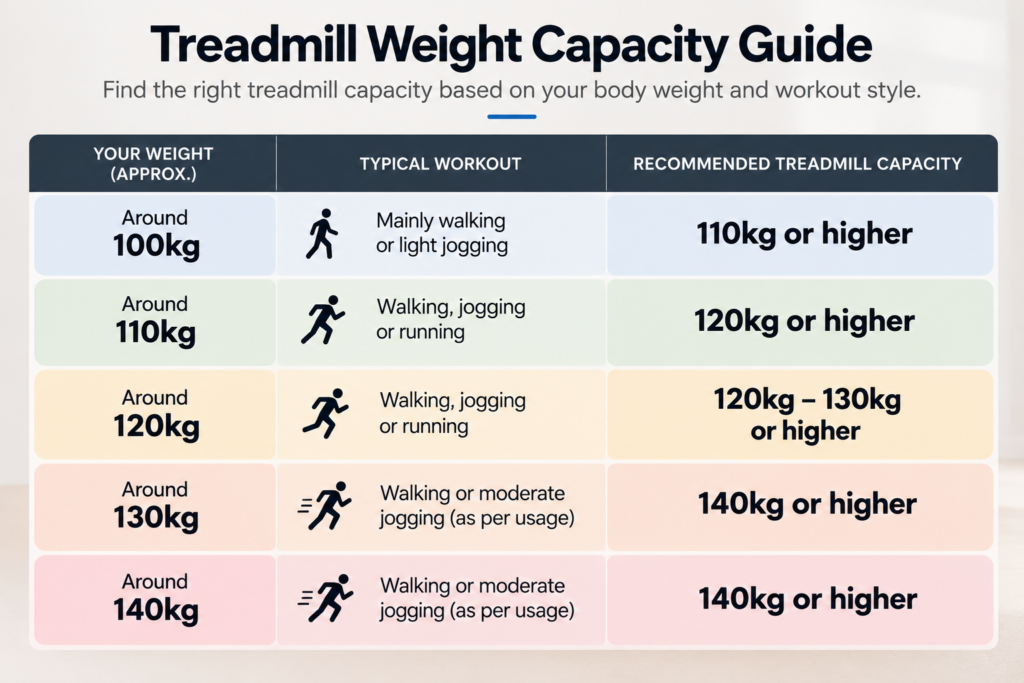
  • Buying a treadmill when you’re around 100kg, 110kg, 120kg or more isn’t quite as simple as finding a machine with a matching number on the specification sheet. A treadmill rated for 110kg, for example, doesn’t necessarily mean it’s the right choice for a 110kg person who plans to run on it every day. Walking, jogging and running place different demands on the machine, which is why treadmill weight capacity needs to be considered alongside the motor, running surface, cushioning and intended workout. PowerMax’s home-use range includes treadmills across the 110kg, 120kg, 130kg and 140kg capacity classes, giving you several options depending on how you actually plan to train.

    So, if you’re searching for the best PowerMax treadmill for 110kg, 120kg or 140kg users, here’s what you should look at before choosing one.

    What Does Maximum User Weight on a Treadmill Actually Mean?

    The maximum user weight is the highest weight specified for the treadmill. But it shouldn’t automatically be interpreted as the ideal weight for every type of workout. This is especially relevant when you’re comparing a Treadmill For Home for walking with one that you’ll use for regular jogging or running. PowerMax’s own product guidance gives an example of this distinction. The TDM-97 has a maximum user weight of 110kg, but PowerMax recommends an additional 25kg buffer for running, meaning the running recommendation is lower than its maximum walking capacity. The same principle appears on the UrbanTrek TD-M1. It is rated for a maximum user weight of 120kg, while PowerMax recommends a 25kg buffer for running and gives 95kg or less as an example for that activity. That’s why the right question isn’t simply:

    “How much do I weigh?”

    It is:

    “How much do I weigh, and what am I going to do on the treadmill?”

    Best PowerMax Treadmill for a 110kg User

    If you’re around 110kg, PowerMax has several home-use treadmills in this capacity class. The current range includes models such as the TDM-95, TDM-96B, TDM-97, TDM-98 and TDA-95. Several of these have 110kg maximum user capacities and running surfaces around 1100 × 400mm. For someone primarily interested in walking or lighter home cardio, a 110kg treadmill can be an option when that use falls within the manufacturer’s recommendations. If you’re planning to jog or run regularly, however, it’s worth considering a higher-capacity treadmill rather than buying one simply because its maximum user weight matches your body weight.

    PowerMax TDM-96B for Home Use

    The TDM-96B is one of the PowerMax home-use options in the 110kg category. It uses a 4HP DC motor and has a 1100 × 400mm running surface. The model also includes a four-level manual incline, PVC cushion shock absorption, 12 preset programs, Bluetooth connectivity and hydraulic soft-drop folding. For a buyer looking for a home use treadmill around the 110kg capacity class, the TDM-96B gives you a useful example of what to compare: capacity, motor, deck size, cushioning, incline and everyday features rather than capacity alone.

    What If You Weigh Around 100kg?

    This is where choosing purely by search category can become misleading. Someone weighing 100kg might naturally search for a 100kg treadmill, but if they intend to jog or run, a treadmill with additional capacity can make more sense. PowerMax’s treadmill buying guidance recommends leaving additional capacity above your body weight, particularly for higher-impact workouts. So a 100kg user shouldn’t automatically stop looking at 110kg or 120kg treadmills. The extra capacity can be particularly relevant if running is part of the plan.

    Best PowerMax Treadmill for a 120kg User

    Once you move into the 120kg treadmill category, the running surface and overall construction become even more useful points of comparison. One PowerMax home-use example is the UrbanTrek TD-M1.

    It has a 6.0HP HiTorque BLDC motor, 120kg maximum user capacity, 1210 × 410mm running surface, 1-14km/h speed range and two-level manual incline. It also uses ComfortTech 6-point damping with a double-layer running board. The running surface is worth noticing here. A treadmill’s maximum user weight tells you about capacity, but the running deck tells you something about the space you’ll actually have underneath your feet. For taller users or people with a longer stride, that can become just as important. The TD-M1 also includes 12 preset programs, three target-based modes, Bluetooth connectivity and a hydraulic soft-drop folding system. For someone searching for the best treadmill for a 120kg user, these are the specifications worth comparing rather than simply looking for “120kg” on the product title.

    Best PowerMax Treadmill for a 140kg User

    At around 140kg, the capacity question becomes even more important. PowerMax currently has home-use models in the 140kg category, including the TDA-230 and TDA-230M. The TDA-230M, for example, has a 140kg maximum user weight, 5HP DC motor, 1200 × 420mm running surface, 1-14km/h speed range and 15-level auto incline. It also includes cushion shock absorption, a diamond wave running belt, precision-machined steel-crowned rollers and 12 preset programs. For a 140kg user, don’t just search for a treadmill that says “140kg” and stop there. Look at how the manufacturer defines that capacity for walking, jogging and running.

    What About a 130kg User?

    The 130kg category is worth mentioning even though it isn’t in the title. That’s because PowerMax has several home-use treadmills rated at 130kg, including the TDM-100M, TDM-125, TDA-100, TDA-125 and TDA-330. For someone around 130kg, this gives you another capacity class to consider rather than jumping directly from 120kg to 140kg. And again, the workout matters. A person looking for a treadmill mainly for walking has different requirements from someone looking for a Running Machine for regular high-speed workouts.

    What If You Weigh 150kg?

    “Treadmill for 150kg user” is a natural search query, but this is where you need to be careful with maximum user weight.

    A treadmill rated at 150kg should not automatically be interpreted as the ideal treadmill for a 150kg user who wants to run. The manufacturer’s stated activity recommendations matter. If you’re around 150kg, check the current PowerMax home-use specifications and usage guidance rather than choosing a treadmill simply because the maximum number matches your body weight.

    Don’t Choose a Treadmill by Weight Capacity Alone

    Weight capacity is important, but it is only one part of choosing the right Home Fitness Equipment.

    Motor

    Motor specification matters when you plan to use the treadmill regularly, particularly for jogging and running. Don’t compare horsepower without also looking at the rest of the treadmill’s specifications and intended use.

    Running Surface

    A larger running surface can provide more room for your stride and movement. For example, the TDM-96B has a 1100 × 400mm running surface, while the UrbanTrek TD-M1 provides 1210 × 410mm. The TDA-230M offers 1200 × 420mm.

    Cushioning

    If you’re going to spend a lot of time walking or running, the treadmill’s cushioning system is worth looking at. It affects how the deck feels underfoot and how impact is managed during your workout.

    Speed

    A treadmill for walking doesn’t need to be evaluated in exactly the same way as one you’re buying for regular running. Check the speed range against the workouts you actually plan to do.

    Incline

    If incline walking or hill-style workouts are part of your routine, look at the type and range of incline available. The TDM-96B uses manual incline, while the TDA-230M offers 15-level auto incline.

    Workout Type

    This may be the most overlooked factor. Someone looking for a treadmill for daily walking shouldn’t necessarily shop the same way as someone planning frequent running sessions. Before comparing Treadmill Price, decide what you actually need the treadmill to do. For a broader explanation of how to read specifications such as maximum user weight, motor power and running belt dimensions, PowerMax’s How to Read Fitness Equipment Specs Like a Pro guide is also useful.

    Which PowerMax Treadmill Should You Choose?

    Here’s the simplest way to think about the different weight categories:

    Your approximate weightWhat to considerPowerMax home-use example
    Around 100kgLook for capacity above your body weight if you plan to jog or run110kg+ models
    Around 110kg110kg models can suit appropriate walking use; consider more capacity for higher-impact workoutsTDM-96B
    Around 120kgLook closely at capacity, running surface, cushioning and workout typeUrbanTrek TD-M1
    Around 130kgCompare 130kg and 140kg capacity classes according to your intended workoutPowerMax 130kg models
    Around 140kgPay close attention to the manufacturer’s activity recommendationsTDA-230M
    Around 150kgDon’t assume matching maximum capacity means suitability for runningCheck current higher-capacity options

    The important word here is “around.” You don’t need to find a treadmill whose maximum user weight exactly matches the number on your weighing scale. You need to consider your weight, your workout and the capacity recommended for that activity.

    So, What Is the Best PowerMax Treadmill for Your Weight?

    There isn’t one PowerMax treadmill that makes sense for every user. If you’re around 110kg and mainly want a home treadmill for walking, the 110kg category gives you several options, including the TDM-96B. If you’re around 120kg, the UrbanTrek TD-M1 provides a 120kg capacity with a larger running surface and BLDC motor. For users around 140kg, PowerMax’s 140kg home-use range provides higher-capacity options such as the TDA-230M, subject to current availability and the manufacturer’s activity guidance. The smarter way to shop is to look beyond the number.

    Your weight tells you where to start. Your workout tells you what capacity and specifications you should actually look for.

    FAQs

    What is the best treadmill for a 110kg user?

    Start with PowerMax’s 110kg home-use treadmills, but consider additional capacity if you plan to jog or run regularly. The TDM-96B is one current PowerMax option in this category.

    What is the best treadmill for a 120kg user?

    Look at PowerMax’s 120kg home-use options and compare the running surface, motor, cushioning, speed and intended workout. The UrbanTrek TD-M1 is one example, with a 120kg capacity and 1210 × 410mm running surface.

    What is the best treadmill for a 140kg user?

    PowerMax has 140kg home-use models such as the TDA-230M. However, maximum user weight should not be treated as the recommended running weight without checking the individual product guidance.

    Should I buy a treadmill with exactly my body weight capacity?

    Not necessarily. If you plan to jog or run, additional capacity can be useful. Always check the manufacturer’s recommendations for your intended activity.

    Is a 130kg treadmill suitable for a 120kg user?

    It can be, depending on your workout and the treadmill’s other specifications. A higher capacity can provide additional headroom, but motor, running surface, cushioning and speed should also fit your needs.

    Can a 100kg person use a 110kg treadmill?

    A 110kg treadmill may be appropriate for a 100kg user depending on the intended activity and the manufacturer’s recommendations. For regular running, look at the recommended buffer rather than capacity alone.

  • If you’re looking for a treadmill for home, you’ve probably noticed “BLDC motor” showing up in newer models. But what does BLDC actually mean, and is it really worth choosing over a conventional treadmill? The short answer: BLDC can be a great choice for home workouts, but the motor isn’t the only thing that matters.

    What Is a BLDC Treadmill?

    BLDC stands for Brushless DC motor. Unlike brushed motors, it doesn’t rely on physical brushes for power transfer. This design can provide smooth motor operation, efficient power delivery and less mechanical wear. For home users, that can be useful when you want regular walking, jogging or running without making your treadmill feel like a heavy-duty commercial gym machine. But here’s the important part: BLDC doesn’t automatically mean “better.” Running surface, speed, cushioning, incline, user capacity and overall construction still have a major impact on your workout.

    Why BLDC Makes Sense for Home Use

    A home treadmill usually needs to do three things well: perform consistently, fit comfortably into your space and handle your regular workout routine. That’s where BLDC technology becomes interesting. Its brushless design can offer efficient and smooth performance, making it particularly appealing for people who want a treadmill they can use regularly at home. Still, if you’re only walking for 20- 30 minutes a day, you may not need to spend extra simply for the BLDC label.

    Powermax TD-A1: The Performance-Focused Option

    If you want a more powerful BLDC treadmill for home workouts, the Powermax UrbanTrek TD-A1 is one of the stronger options in the range. It uses a 6.0 HP BLDC motor, offers speeds up to 14 km/h, a 1210 × 410 mm running surface and 15-level auto incline.For someone who wants more than casual walking, the combination of BLDC power, larger running space and auto incline makes the TD-A1 particularly interesting for home cardio.

    Powermax TDM-95: A More Affordable Alternative

    You don’t necessarily need a premium treadmill to get brushless-motor technology. The Powermax TDM-95 is designed specifically for home use and features a DC brushless motor, speeds from 1-10 km/h and a maximum user capacity of 110 kg. Its 950 × 385 mm running surface keeps the machine relatively compact. This makes it more suitable for someone whose routine is primarily walking and light jogging, rather than intensive running.

    BLDC vs Regular Treadmill: Which Should You Buy?

    Think about your actual workout before looking at the motor badge. If you’re a regular runner who wants higher speeds, incline workouts and a more substantial running deck, a stronger BLDC treadmill like the TD-A1 makes more sense. If your goal is simply to walk, stay active and get your cardio done at home, the TDM-95 can be a more practical option. The best treadmill isn’t necessarily the one with the biggest motor. It’s the one that matches your routine.

    Is a BLDC Treadmill Worth It?

    For home use, yes, BLDC is worth considering. Its brushless design, smooth operation and efficient performance make it an attractive option for regular home cardio. But don’t let “BLDC” be the only specification you compare. Look at the running surface, speed, incline, cushioning, weight capacity and available space before making your decision.

    FAQs

    Is a BLDC treadmill good for home use?

    Yes. BLDC treadmills can be an excellent choice for home users, particularly if you want smooth and efficient performance for regular workouts.

    Is BLDC better than a normal DC motor?

    BLDC motors have the advantage of a brushless design and potentially lower mechanical wear, but the overall treadmill design matters just as much.

    Is a BLDC treadmill good for running?

    Yes, provided the treadmill has enough speed, running space, cushioning and user capacity for your running style.

    Which Powermax BLDC treadmill is better for home use?

    For more demanding cardio and running, the TD-A1 offers substantially more speed, running space and incline capability. For basic home walking and light jogging, the TDM-95 is the simpler and more affordable option.

    Final Thought: 

    BLDC technology is a genuine advantage, but the right treadmill depends on how you plan to use it. For casual home walking, keep it practical. For serious home cardio, look for the extra performance features that you’ll actually use.

  • Most people don’t expect much from walking. It feels simple. Almost too simple to create real change. But give it 30 days, done consistently on a treadmill for home workouts and your body starts responding in ways you don’t immediately notice, but definitely feel. Not dramatically. Not overnight. But steadily.

    Week 1: It Feels Harder Than Expected

    The first few days are always the most surprising. Even walking for 15-20 minutes can feel tiring if your body isn’t used to regular movement. Your legs feel heavier, your breathing feels slightly off, and motivation dips quicker than expected. This is where most people quit.

    But if you keep going even at a slow pace, your body starts adapting faster than you think.

    Week 2: Your Energy Starts Changing

    Somewhere around the second week, things begin to shift. You don’t feel as tired after walking. In fact, you start noticing the opposite, slightly better energy during the day. That constant sluggishness begins to fade.

    This is where using a reliable setup matters. A smooth machine like the
    Powermax Fitness TDM-96B makes it easier to stay consistent because the experience itself feels effortless and uninterrupted.

    Week 3: Your Body Starts Adapting

    By the third week, your body becomes more efficient. Your pace improves naturally. What felt difficult earlier now feels manageable. You may even start increasing speed or adding a slight incline without forcing it.

    This is where a good treadmill DC motor makes a difference. A smooth, stable machine allows you to gradually push intensity without discomfort, which keeps the routine sustainable.

    At the same time, options like Lifelong Fit Pro 4.5 HP Motorised Treadmill
    also offer accessible entry-level setups for those starting their home fitness journey.

    Week 4: Visible and Mental Changes

    After about 30 days, the changes become more noticeable. Your stamina improves. Walking feels easier, and you recover faster. Some people notice slight fat loss, especially when combined with a basic routine. But the biggest shift isn’t physical, it’s mental. You stop negotiating with yourself. The routine becomes automatic. That’s the real transformation.

    Why It Works (Even Though It Feels Simple)

    Walking works because it’s repeatable. It doesn’t drain you. It doesn’t require recovery days. And most importantly, it’s easy to maintain, even on busy schedules. That’s why something as simple as a treadmill for home use can be more effective long-term than complicated routines that don’t last.

    What Most People Get Wrong

    The mistake isn’t doing too little. It’s expecting too much, too quickly. Daily walking isn’t meant to shock your body. It’s meant to build consistency. And over time, that consistency compounds into real results.

    Final Thoughts

    After 30 days of daily treadmill walking, you may not look completely different. But you’ll feel different. Stronger. Lighter. More consistent. And once that habit is built, everything else, fat loss, stamina, fitness becomes easier to improve.

    Because in the end, it’s not about intensity. It’s about showing up, every single day.

  • In 2026, the fitness landscape has shifted. We aren’t just looking for machines; we are looking for ways to reclaim our time and mental space. While gym memberships remain popular, the question of whether a home treadmill is a “smart investment” or a “dust collector” comes down to one thing: consistency.

    The true value of a treadmill in 2026 isn’t just the belt and motor; it’s the removal of friction. When the “commute” to your workout is simply walking into the next room, the excuses that usually stop us, bad weather, heavy traffic, or feeling self-conscious, simply disappear.

    The Hidden Economics: Breaking Down the “Cost-per-Use”

    When you calculate the cost of a high-quality machine over a 5-to-7-year lifespan, the “cost per walk” often drops below the price of a daily cup of coffee. Unlike a gym membership that vanishes if you don’t go, a treadmill is a physical asset that adds value to your lifestyle and even your home’s “wellness” appeal.

    Think of it as “Health Insurance you actually enjoy.” In 2026, the trend of “Hybrid Fitness” has proven that having equipment at home doesn’t just save money on fuel and membership fees; it saves your most non-renewable resource: time. Those 45 minutes spent driving to the gym and back can now be spent actually moving, sleeping, or being with family.

    Mental Clarity and the “Ghost Fatigue” Solution

    We often feel exhausted after a long day of work, but this is usually “mental fatigue,” not physical. A light 20-minute jog or a brisk walk is the most effective way to clear that brain fog. By moving your body, you’re essentially “resetting” your nervous system.

    Modern treadmills in 2026 are designed to be “wellness hubs.” With advanced shock absorption that mimics a professional track, you are protecting your joints from the brutal impact of concrete. This means you can stay active well into your later years without the “wear and tear” that usually comes with outdoor running. Plus, you gain the “Multi-Tasking Edge”, you can catch up on work calls, watch a documentary, or listen to a podcast without the safety risks of outdoor traffic.

    Comparing the Indian Market Leaders

    If you are looking for a blend of industrial-strength durability and smart, space-saving technology, you might consider the PowerMax Fitness Treadmill Series, which is specifically designed to handle the climate and power needs of Indian households with robust motor reliability, lifetime frame warranties, and semi-auto lubrication features.

    On the other hand, for those who are just starting out and looking for an entry-level, budget-friendly solution for power walking or light jogging, a brand like Sparnod Fitness offers a variety of compact models that focus on basic digital connectivity and sleek designs suited for smaller apartment spaces.

    The Verdict: Is It for You?

    A treadmill is worth the investment if you value the privacy of a “judgment-free zone” and the freedom to move on your own schedule. It’s not about owning a machine; it’s about owning your health. In 2026, the best project you’ll ever work on is YOU and sometimes, the best way to start that project is by taking the first step right in your own living room.

  • Investing in the best gym equipment for your long-term wellness goals is one of the most substantial investments you can make in 2025. Finding the best brand with many options flooding the Indian market takes a careful look at durability, technology, and after-sales support. Whether you are looking for a high-performance treadmill machine or a versatile home gym set, the brand chosen by you would last in order to keep the consistency of your workouts. Since there are several brands in the current industry, below are the top five leading brands that do quality fitness equipment for every type of athlete.

    PowerMax Fitness: The Industry Leader

    PowerMax Fitness was regarded as the best fitness equipment brand in India due to the availability of a complete range of cardio fitness equipment, along with strength fitness equipment. They are quite famous and known for producing the best treadmill in India, having advanced AC motor technology in treadmills for commercial and home users. These products are designed in such a way that they can easily bear the burden of extended utilization, thus making them the first choice for those planning to purchase a motorized treadmill unit that will last long. In addition to cardio, they also manufacture strong multi-gym machine units and smith machines that provide one with the opportunity to create a professional level environment within the comfort of home. Their commitment to excellence ensures they remain the high-grade provider of exercise equipment for those who refuse to compromise on performance.

    Sparnod Fitness: Innovation at Affordable Costs

    For those looking for affordable fitness equipment, without compromising on modern features, Sparnod Fitness stands out from the crowd. Specializing in stylish and functionally competent home workout equipment, they have earned a reputation among city people who have little space within their apartments for massive equipment. Its treadmill for home range often features foldable designs and intuitive consoles that show your progress in real time. Their running machine price is relatively more affordable without compromising on quality, offering a wide array of exercise bikes and ellipticals that can deliver a smooth, low-impact workout. Sparnod is an excellent entry point for beginners who want to set up a home exercise equipment station without making a huge initial investment.

    Durafit: Built for Endurance

    Durafit has established its name in the top brands for treadmills in India due to its heavy orientation to structural integrity and motor power. Their machines are specifically made for serious runners who require a running machine that gives them high speed and longitude. Most of their high-end models boast of a heavy-duty treadmill DC motor or AC motor that makes sure the motorized treadmill price corresponds with a product fit for longevity. For those fitness enthusiasts who place a steady and reliable electric treadmill experience as their priority, the Durafit model promises top-rated fitness equipment with the feel of a professional gym. They are the necessary partner on whom one can rely when the prime priority is cardiovascular health and marathon preparation. 

    Cockatoo: The Expert in Home Use Equipment 

    Cockatoo has been in the development and production of top-notch and best treadmill for home uses, focusing on user experience and compact design. They are highly reputed for their elliptical cross trainer for home use and special variants of rowing machines that aim at full-body conditioning. Cockatoo keeps a competitive fitness equipment price, hence making health easy to be integrated into any family’s lives. Their line of home fitness equipment is designed to be very quiet and efficient for residential settings. Be it your manual treadmill or high-tech treadmill machine; Cockatoo seems to offer you versatile solutions, ranking high in exercise equipment for sale in the virtual marketplace.

    Welcare: Professional Standards at Home 

    Welcare seems to fill the void between purely commercial fitness equipment and the needs of a residence. An impressive array of strength equipment, including the weight bench to several benches and racks for use within the home setting, is available. Many of their machines can be found in professional gym settings-a testament to their durability and biomechanical precision. For those who desire to have a complete set of home gym equipment, Welcare provides every bit of equipment needed, from a recumbent exercise bike to the high-capacity cardio fitness equipment. Recovery is also important for well-being; hence, Welcare often integrates advanced features into their fitness equipment to make sure that the approach to health is holistic.

    Final Thoughts on Your Investment in Fitness 

    The best brand for gym equipment in India balances your goals with space and budget. Each one of these five brands is a different path to health and fitness-whether you’re looking to replicate a PowerMax Fitness layout at a commercial facility or squeeze in a compact exercise bike in a small home for those quick morning sessions. As you search for treadmills on sale and compare running machine prices from one platform to another, remember that the top treadmill brands are ones that will consistently support you and provide high-quality parts for you. Investing in good-quality gym equipment from a well-known fitness equipment company in India sets you up for success, including being injury-free this 2025.