
• Buying a treadmill online can get confusing pretty quickly. You may see one treadmill for ₹15,000, another for ₹30,000 and another for ₹50,000,  all promising home workouts, motorised running and plenty of features. So what exactly are you paying for? The treadmill price in India can vary significantly depending on the motor, running surface, user capacity, incline system, cushioning, construction and features. Current Indian listings cover everything from compact walking machines to premium home treadmills costing well above ₹50,000.The better question isn’t simply “How much does a treadmill cost?” It’s “What kind of treadmill can I expect at my budget?” This 2026 guide breaks down the treadmill price range in India, what you generally get at different budgets and how much you may actually need to spend for your type of workout.

    How Much Does a Treadmill Cost in India in 2026?

    For home use, treadmill prices currently span a very wide range. As a practical buying guide, you can think about the market like this:

    Treadmill Price RangeWhat You Can Generally Expect
    Under ₹10,000Basic walking pads and entry-level machines
    ₹10,000-₹20,000Budget home treadmills for walking and light workouts
    ₹20,000-₹30,000More capable everyday home-use treadmills
    ₹30,000-₹50,000Better-equipped treadmills for regular home workouts
    ₹50,000-₹75,000Higher-end home treadmills with stronger specifications
    ₹75,000+Premium home-use machines and more specialised equipment

    These aren’t fixed industry categories. There is plenty of overlap between price bands, and a discounted treadmill can move into a completely different budget category overnight.

    Treadmill Price Under ₹10,000

    At the lowest end of the treadmill price range, you’re mostly looking at compact walking machines, walking pads and very basic treadmills. This budget can make sense if your main goal is simply to walk at home, particularly if space is limited. You should be more careful if you’re looking for a machine for regular jogging or running. At this price, running surface, motor capability and overall construction can become limiting factors. A cheap treadmill isn’t automatically a bad treadmill. It just needs to match the workout you’re actually planning to do.

    Best suited for:

    • Basic home walking
    • Light daily activity
    • Small apartments
    • Users who prioritise compact storage
    • Occasional rather than intensive workouts

    If your goal is regular running, it is usually worth looking at the next few price brackets rather than choosing solely on the lowest treadmill price.

    Treadmill Price Between ₹10,000 and ₹20,000

    This is where the budget starts becoming more interesting for home buyers. You can find entry-level motorised treadmills designed for everyday walking and lighter cardio workouts. The exact specifications vary considerably, so this is where comparing the motor, belt size, speed and user capacity becomes more useful than simply looking at the price. For example, the PowerMax TDM-95 is currently listed at ₹14,999. It has a 4HP DC brushless motor, 110kg maximum user weight, 1-10 km/h speed range, two-level manual incline and a 950 × 385mm running surface.  This illustrates an important point about treadmill price in India: you don’t necessarily have to spend ₹30,000 or ₹40,000 just to get a motorised treadmill for home use. But you should know what you’re giving up as the budget comes down, particularly running space, speed range and additional features.

    Treadmill Price Between ₹20,000 and ₹30,000

    For many home buyers, this is a particularly useful middle ground. You can start finding treadmills with larger running surfaces, higher speed ranges, better cushioning and more convenience features without moving into premium pricing.

    The PowerMax TDM-96B, for example, is currently ₹21,999. It has a 4HP DC motor, 110kg maximum user weight, 1-14 km/h speed range, 1100 × 400mm running surface, four-level manual incline, cushioning, Bluetooth connectivity and hydraulic soft-drop folding.  At ₹25,499, the PowerMax TDM-97 sits in the same broad price bracket, with a 4HP DC motor, 110kg maximum user weight and 1100 × 400mm running surface. This is why a treadmill under ₹30,000 can be a sensible starting point for someone looking for more than basic walking.

    Treadmill Price Between ₹30,000 and ₹50,000

    Move into this range and you’re generally looking at more feature-rich home treadmills. The difference isn’t necessarily about adding flashy extras. You may get a more substantial running surface, better cushioning, higher speed capability, more workout programmes, improved convenience features or a stronger overall specification. The PowerMax TDM-98, currently ₹32,744, is one example. It has a 4HP DC motor, 110kg maximum user weight, 1100 × 400mm running surface, three-level manual incline, multiple workout programmes, shock-absorption features and a foldable design. At the upper end of this bracket, the PowerMax TDM-96M is currently ₹48,400. It adds features such as four-level manual incline, Bluetooth app connectivity, 12 preset programmes, a 1050 × 410mm running surface and additional entertainment features. For someone who expects to use a treadmill frequently, this is the point where it makes sense to stop thinking purely in terms of treadmill price and start comparing the complete specification.

    Treadmill Price Between ₹50,000 and ₹75,000

    This is a higher-end home-use budget. Here, buyers can start looking for treadmills with stronger motors, larger running areas, higher user capacities, more substantial decks and additional workout or convenience features. For example, the PowerMax TDM-100M is currently priced at ₹55,188. It has a 5HP DC motor, 130kg maximum user weight, 1200 × 400mm running surface, three-level manual incline, 12 preset programmes, Bluetooth connectivity and a multifunction massage feature. A budget above ₹50,000 therefore isn’t automatically about buying a treadmill with more buttons. It can make sense when you need a higher user capacity, larger running area or more substantial specification for frequent home workouts.

    What Makes One Treadmill Cost More Than Another?

    Two treadmills can look surprisingly similar while having very different prices. The main differences usually come down to the hardware and how the treadmill is intended to be used.

    Motor

    Motor specification is one of the first things buyers notice, but don’t judge a treadmill by the HP number alone. Look at the complete specification alongside the intended workout, speed range and user capacity. A treadmill designed primarily for walking doesn’t need to be judged by exactly the same criteria as one intended for frequent running.

    Running Surface

    The running surface becomes increasingly important as speed and stride length increase. A compact belt can work well for walking, but runners generally benefit from having more room to move naturally.

    User Weight Capacity

    The maximum user weight is another major part of the specification. Don’t treat the published maximum as your ideal target. If you’re planning to run regularly, having some capacity headroom can be useful for stability and long-term use.

    Incline

    Manual incline and automatic incline are different systems and can affect both the treadmill’s price and the workout experience. If you rarely use incline, there may be little reason to pay significantly more for an advanced incline system.

    Cushioning

    Better cushioning can make a noticeable difference when you’re walking or running frequently. It’s particularly worth paying attention to if the treadmill will be used for longer sessions or by multiple members of the household.

    Build and Construction

    Frame strength, deck construction, rollers, belt quality and overall machine design all contribute to the cost. These aren’t features that necessarily look impressive in a product photograph, but they matter when the treadmill is used regularly.

    Features and Connectivity

    Bluetooth, workout programmes, speakers, app compatibility, display systems and folding mechanisms can all increase the price. The trick is knowing which ones you’ll actually use.

    Is a More Expensive Treadmill Always Better?

    No. A ₹50,000 treadmill isn’t automatically the right choice for someone who only walks for 30 minutes a day. Likewise, choosing the cheapest treadmill available may not make sense for someone who wants to run several times a week. The best treadmill for home use is the one whose specifications fit your workout. Think about: How often will you use it? Are you walking, jogging or running? How much space do you have? What is the user’s weight? Do you need an incline? How much running surface do you want? Will several people use the treadmill? Answer those questions first. Then look at the price.

    How Much Should You Spend on a Treadmill?

    There’s no single number that works for everyone. A useful way to think about your budget is:

    Your Main GoalSensible Budget Approach
    Occasional walkingEntry-level
    Daily walking₹10,000-₹20,000+
    Walking + regular jogging₹20,000-₹30,000+
    Regular home running₹30,000-₹50,000+
    Frequent use / higher user capacity₹50,000+

    These are guidelines, not rules. Someone may find everything they need at ₹20,000, while another buyer may need to spend ₹50,000 or more because of their weight, running requirements, space or desired features.

    Treadmill Price vs Features: What Is Actually Worth Paying For?

    When comparing a ₹20,000 treadmill with a ₹40,000 treadmill, don’t ask only: “Which one has more features?” Ask: “Which features will actually change my workout?” A larger running surface can be more valuable than a bigger display. A suitable user-weight capacity can matter more than Bluetooth. Good cushioning can be more useful than additional preset programmes. And a treadmill that fits your available space is obviously more useful than one that looks impressive on paper but ends up sitting unused because it is difficult to store. That’s where quality fitness equipment starts to make more sense than simply chasing the lowest price.

    PowerMax Treadmill Price Range in 2026

    PowerMax’s current home-use treadmill selection covers several price points, which makes it possible to choose according to budget rather than forcing every buyer into the same model. Some current examples include:

    ModelCurrent PriceMax User Weight
    TDM-95₹14,999110kg
    TDM-96B₹21,999110kg
    TDM-97₹25,499110kg
    TDM-98₹32,744110kg
    TDM-96M₹48,400110kg
    TDM-100M₹55,188130kg

    Current prices and specifications are based on PowerMax’s website and can change with promotions, availability and other commercial factors. The useful takeaway isn’t that one of these is automatically the “best” treadmill. It’s that different budgets can buy very different types of home fitness equipment, and your workout requirements should decide where you sit within that range.

    What Is a Good Treadmill Budget for Home Use?

    For many buyers, ₹20,000-₹30,000 is a useful starting point for a motorised home treadmill because you can move beyond the most basic machines without immediately entering the higher-end price brackets. If you’re primarily walking, you may be perfectly comfortable spending less. If you want regular running, greater user capacity, a larger running surface or more substantial construction, moving toward ₹30,000-₹50,000 or beyond may make more sense. The right treadmill budget isn’t about spending the most. It’s about spending enough to get the specifications you’ll actually use.

    FAQs About Treadmill Price in India

    How much does a treadmill cost in India in 2026?

    Treadmill prices vary widely. Entry-level walking machines can be found below ₹10,000, while home-use motorised treadmills commonly move through the ₹10,000-₹50,000 range, with premium options costing considerably more.

    What is a good treadmill price for home use?

    For many home buyers, ₹20,000-₹30,000 is a practical starting range for a motorised treadmill. However, the right budget depends on whether you plan to walk, jog or run and how frequently you’ll use the machine.

    Is a ₹20,000 treadmill worth buying?

    It can be. A treadmill around ₹20,000 can make sense for regular home walking and lighter cardio, provided its motor, running surface and user capacity match your requirements.

    Should I buy a treadmill for under ₹20,000 or ₹30,000?

    If your main goal is walking, under ₹20,000 may be enough. If you want more running space, a higher speed range, incline or additional features, moving toward ₹30,000 can give you more options.

    What affects treadmill price in India?

    Motor specification, running surface, user capacity, incline, cushioning, frame and deck construction, programmes, connectivity, folding mechanisms and warranty/service can all influence treadmill price.

    Are expensive treadmills always better?

    No. A more expensive treadmill may have specifications you don’t need. The best choice depends on your workout, body weight, available space, frequency of use and desired features.

    What is the difference between a ₹20,000 and ₹50,000 treadmill?

    The difference can include running surface, motor specification, user capacity, cushioning, incline, construction and convenience features. However, there is no universal rule that every ₹50,000 treadmill is better than every ₹20,000 treadmill.

    How much should I spend on a treadmill for running?

    Regular runners should look beyond price and pay particular attention to the running surface, speed range, user capacity, cushioning, motor and overall construction. For many home runners, starting around ₹30,000-₹50,000 gives more options, but individual requirements vary.

    Final Word

    The treadmill price in India has become broad enough that there’s no longer a single “normal” price for a home treadmill. You can spend under ₹20,000 for a basic machine, move toward ₹30,000 for a more capable everyday treadmill, or spend ₹50,000+ when you need higher specifications and more features. The smartest approach is to work backwards from your workout. Walking? Don’t overspend. Regular jogging? Look for a better combination of motor, belt and cushioning. Frequent running or higher user weight? Give greater priority to capacity, running surface and construction.
  • The motor is usually the first specification people look at when buying a treadmill online. Then comes the confusing part: AC motor, DC motor, peak HP, continuous HP, brushless motor. A treadmill can suddenly feel more like a technical purchase than fitness equipment. But the choice between an AC and DC motor is actually easier when you look at how you plan to use the treadmill. For most home users, a good DC treadmill is more than enough. AC motors become more attractive when the treadmill will handle longer sessions, multiple users or heavier training. So, which one should you buy?

    AC vs DC Treadmill: The Quick Difference

    The simplest way to look at it is this:

    FeatureDC Motor TreadmillAC Motor Treadmill
    Best suited forHome useHeavy home or commercial use
    NoiseGenerally quieterCan be louder
    Typical sizeCompact to mediumLarger and heavier
    Continuous useBetter for normal home sessionsBetter for extended use
    Multiple usersOccasional family useBetter for frequent shared use
    PriceUsually more affordableUsually more expensive
    MaintenanceSuitable for regular home useDesigned for heavier workloads
    Best forWalking, jogging and regular runningLong sessions, serious running and gym use

    PowerMax itself notes that DC motors are quieter and consume less power, while AC motors are designed for continuous operation. For typical home sessions, DC can be a practical choice.

    What Is a DC Motor Treadmill?

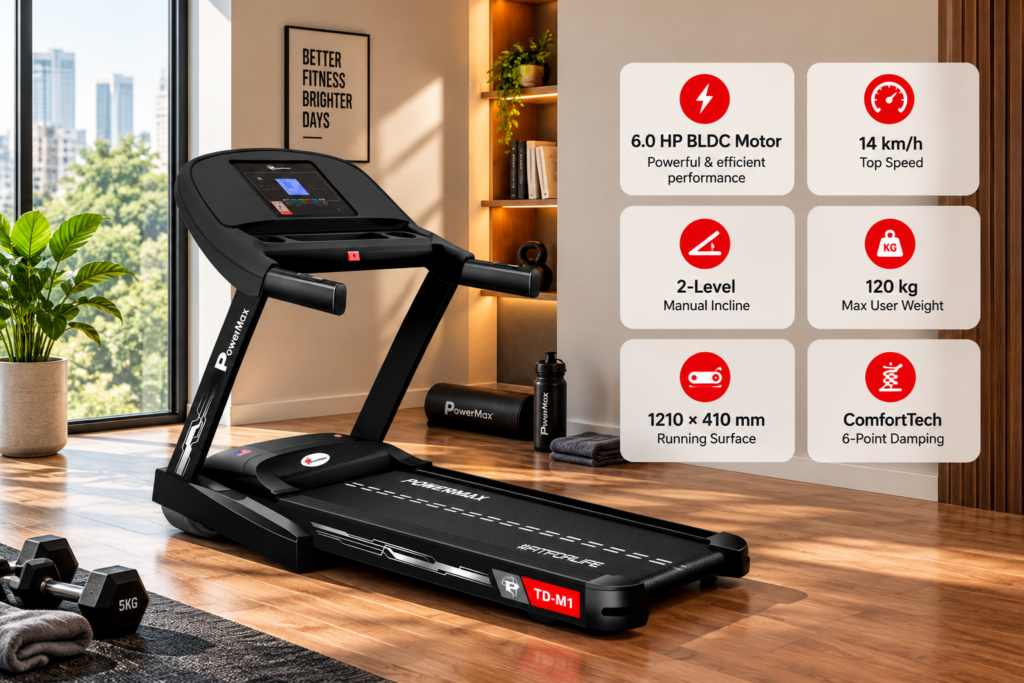
    A Treadmill DC Motor is commonly found in home-use treadmills. It works particularly well for the kind of workout most people actually do at home: walking after work, a 30-minute jog before breakfast or a few kilometres while catching up on a show. Another advantage is noise. If your treadmill is going into an apartment or bedroom, a quieter motor can make the experience much easier to live with. That is one reason DC treadmills remain popular across the Treadmill For Home category. For example, if you’re buying specifically for home use, the PowerMax UrbanTrek TD-M1 is another example worth looking at. It uses a 6.0HP HiTorque BLDC motor and reaches speeds of up to 14 km/h, with a 1210 × 410 mm running surface and 2-level manual incline. It also includes a ComfortTech 6-point damping system, foldable design, Bluetooth connectivity and 12 preset workout programs. 

    When Does an AC Motor Treadmill Make More Sense?

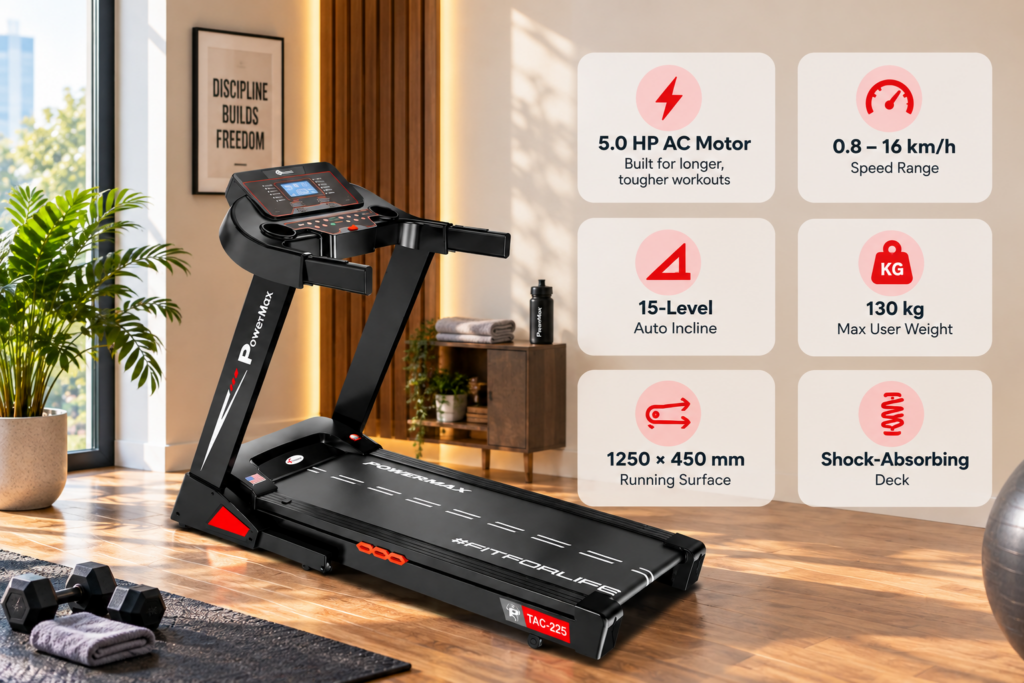
    An AC Motor Treadmill starts making more sense when your treadmill is going to work harder. Think about a family where two or three people use the machine every day. Or a serious runner who regularly does long sessions. Or a small professional gym where the treadmill may be running repeatedly throughout the day. AC motors are designed for sustained workloads and are commonly used in commercial and semi-commercial treadmills. If you’re considering an AC Motor Treadmill for more demanding home workouts, the PowerMax TAC-225 is a good example of what you get when you move into a higher-performance setup. It uses a 5.0 HP AC motor, supports users up to 130 kg and offers speeds from 0.8-16 km/h. Its 1250 × 450 mm running surface and 15-level auto incline also make it better suited to longer and more varied running sessions. The bigger running surface and higher speed range also matter here. Motor type shouldn’t be considered separately from the rest of the treadmill.

    AC vs DC: Which One Is Better for Home Use?

    This is where treadmill buying advice often gets unnecessarily complicated. If you’re buying a treadmill for normal home workouts, DC is usually the sensible starting point. Walking, jogging and moderate running don’t automatically require an AC motor. A quality DC treadmill with an appropriate running surface, sensible user-weight capacity and suitable motor rating can handle regular home workouts well. PowerMax states that its DC treadmills are generally intended for sessions of around 45-50 minutes before a rest period, while AC models can be used continuously. That distinction matters much more than simply seeing “AC” and assuming it means “better.”

    Choose DC if:

    You want a Treadmill For Home for daily walking, jogging or moderate running. You also prefer a quieter machine, a more compact design and a lower Treadmill Price.

    Choose AC if:

    You expect longer running sessions, several users, frequent high-speed workouts or near-continuous use. In those situations, the additional capacity of an AC motor can justify the higher investment.

    Don’t Choose a Treadmill by Motor Type Alone

    This is probably the most useful part of the comparison. A treadmill with a powerful-looking motor specification isn’t automatically the better treadmill. Before buying, look at the running surface, maximum user weight, top speed, incline, cushioning, warranty and the actual motor rating. For example, a taller runner may appreciate a longer running deck more than an extra number printed beside the motor specification. Someone living in a small apartment may care more about folding and noise. And when comparing Motorized Treadmill price, compare the whole machine rather than just the HP figure.

    AC vs DC Treadmill: Which Should You Buy?

    For most people searching for a Best Treadmill For Home, the answer is straightforward. If your routine is built around daily walking, jogging or regular home running, choose a quality DC treadmill that matches your body weight, available space and workout intensity. If you are a serious runner, have several regular users or expect long, repeated sessions, an AC motor treadmill is worth considering. The better motor isn’t the one with the bigger number. It’s the one that matches how you actually plan to use your treadmill.

    FAQs

    Is an AC motor better than a DC motor in a treadmill?

    Not in every situation. AC motors are better suited to continuous and heavy-duty use, while DC motors are generally well suited to regular home workouts.

    Is a DC treadmill good for running?

    Yes. A suitable DC treadmill can handle home running. Check the treadmill’s speed range, running surface, user-weight capacity and motor rating before buying.

    Which motor is quieter, AC or DC?

    DC treadmills are generally quieter, making them attractive for home and apartment use.

    Is an AC treadmill worth the extra money?

    It can be if you need extended running sessions, multiple-user operation or heavier-duty performance. For ordinary home workouts, a quality DC treadmill may offer better value.

    What should I check when buying a treadmill online?

    Look beyond the motor. Check the running belt size, speed range, incline, user-weight capacity, cushioning, folding mechanism, warranty and after-sales support.

    Final Verdict

    The AC vs DC treadmill debate becomes much simpler once you stop asking “Which motor is better?” and start asking “Which motor suits my routine?” For everyday home fitness, a good DC treadmill is often the practical choice. For demanding, long-duration or multi-user workouts, an AC motor offers more headroom. And if you’re shopping for a treadmill online, don’t let a flashy HP number make the decision for you. Match the motor to your workout first. Then compare the rest of the machine.

  • Let’s be honest: the days of staring at a blank wall while you log miles are officially over. As we move through 2026, the best treadmill in India isn’t just about how fast the belt spins; it’s about how well it plugs into your life. Whether you’re looking to join a virtual marathon from your living room or you just want your heart rate to sync instantly with your favorite app, Bluetooth has become the “must-have” feature for every modern runner.

    The market is currently packed with options, but not every “smart” feature actually makes your life easier. We’ve looked at the top contenders for 2026 and found five standout machines. PowerMax Fitness takes our top spot because they’ve managed to nail that tricky balance between high-tech “smarts” and the kind of rugged durability that actually lasts.

    1. PowerMax Fitness: Where Tech Meets Raw Power

    If you’re looking for the best fitness equipment brand in India, PowerMax is usually the first name that comes up, and for good reason. For anyone who needs a treadmill that is both smart and space-saving, the PowerMax TDM-96B Motorized Treadmill is a fantastic choice.

    The Tech: This machine connects effortlessly via Bluetooth to apps like FitShow, Kinomap, and Zwift. It’s a blast to be able to control your workout from your phone and see where you stand on global leaderboards.

    The Edge: What really stands out here is the build quality. The TDM-96B features a 4HP Peak DC motor and a grippy, 1.4mm grass-textured belt. While some brands focus only on the digital bells and whistles, PowerMax makes sure the motorized treadmill itself is tough enough for a serious professional gym setup at home.

    2. Cultsport: The Social Runner’s Paradise

    Cultsport has really figured out how to make fitness feel less like a chore and more like a game. Their Cultsport TurboRun is a go-to for anyone who thrives on a little friendly competition.

    The Tech: These machines sync directly with the Cultsport Play App. You can run through gorgeous virtual worlds and race against other people in real-time.

    The Comparison: The app experience here is top-tier. However, the hardware can sometimes feel a bit lighter than the heavy-duty frames you get with PowerMax. It’s perfect if you love the “gamified” side of fitness, but dedicated marathoners might miss that “industrial” sturdiness.

    3. Durafit: The Reliable Workhorse

    Durafit is a name many Indian families trust because they build machines that just work. The Durafit Ace Pro is their smart answer for the modern runner.

    The Tech: It focuses on the essentials, solid Bluetooth for your music and reliable app connectivity to track your speed and distance.

    The Comparison: Durafit is great if you want a high user weight capacity (up to 120kg) and a stable running surface. The console feels a bit more “old school” than the sleek touchscreens on premium PowerMax models, but it’s a solid, dependable choice.

    4. Sparnod Fitness: Smart Features on a Budget

    If you’re building a home gym set and want to keep things affordable, Sparnod Fitness is a very popular entry-level option. The Sparnod STH-1200 offers a surprising amount of tech for the price.

    The Tech: You get standard Bluetooth speakers and FitShow app support, giving you a connected experience without the premium price tag.

    The Comparison: It’s a great affordable fitness equipment choice, though keep in mind that the motor and belt are generally narrower. It’s perfect for power walking or light jogging, but maybe not for a household of heavy sprinters.

    5. Lifelong: The Smart Choice for Small Spaces

    Lifelong has become a favorite for apartment dwellers. Their Lifelong FitPro series is designed to fit into those tight corners without sacrificing modern perks.

    The Tech: Like the others, it includes Bluetooth speakers and tracks your progress through the FitShow app.

    The Comparison: If your priority is a foldable, space-saving home workout equipment solution, Lifelong delivers. Just remember that because it’s built to be compact, the running deck is a bit smaller than the professional gym grade setups offered by brands like PowerMax.

    Final Thoughts

    At the end of the day, a treadmill is a long-term investment in your health. While Cultsport wins on the app experience and Sparnod wins on price, PowerMax Fitness offers the best “all-in-one” package. By pairing commercial-grade motors with a massive service network and seamless Bluetooth, PowerMax ensures your machine stays smart and actually running for years.

  • When building a home gym in 2025, the debate has shifted from “which brand” to a much more fundamental question: Manual or Motorized? Most fitness enthusiasts assume a treadmill is just a moving belt, but the mechanics behind how that belt moves can either accelerate your progress or completely sabotage your specific fitness goals. At TreadmillReviews.in, we’ve analyzed the top fitness equipment in India to help you decide which engine should power your journey.

    The Power Source: You vs. The Motor

    Manual Treadmills: These are non-electric and powered entirely by your movement. If you want a rugged, multi-purpose tool, the PowerMax MFT-410 is a 4-in-1 powerhouse that includes a jogger, stepper, twister, and push-up bar, making it a favorite for those seeking high-intensity functional training.

    Motorized Treadmills: These use an electric motor to set a consistent pace. For a reliable and sturdy motorized experience, the Sparnod Fitness STH-1200 is a top-rated choice in India, known for its sleek design and user-friendly features that make it ideal for daily home cardio.

    Maximum Calorie Burn

    If your primary focus is weight loss, the manual treadmill, specifically the curved or multi-function manual treadmill is the undisputed king. Because you act as the motor, your body works significantly harder to friction-start the belt and maintain its momentum. Research suggests manual training can burn up to 30% more calories per session compared to standard motorized walking.

    Endurance & Marathon Training

    For those building long-distance stamina, a motorized treadmill is your best partner. Maintaining a rhythmic, consistent pace for 60+ minutes on a manual belt is exhausting and often leads to premature muscle fatigue. A motorized machine allows you to set a “target pace” and utilize auto-incline features to simulate outdoor terrain, ensuring your cardiovascular system is pushed to its limits without tripping over a manual belt’s resistance.

    Quick Comparison: Choosing Your 2025 Setup

    FeatureManual TreadmillMotorized Treadmill
    Best ForHIIT & Rapid Weight LossLong Distance & Stamina
    PowerUser-Powered (Eco-Friendly)AC/DC Motor (Steady Speed)
    SafetyStops when you stopEmergency stop key required
    PriceAffordable Fitness EquipmentPremium Investment

    Final Thoughts: Which One Wins?

    Your choice shouldn’t be based on the treadmill price alone; it must align with your body’s needs:

    Go Manual if you have a “no-excuses” mindset and want a high-intensity, total-body workout in a compact, non-electric format.

    Go Motorized if you prefer data-driven workouts, require joint-protecting shock absorption, or are training for specific distance milestones.

    Stop sabotaging your results by using the wrong tool. Picking a treadmill isn’t just about finding a place to run; it’s about matching the machine’s mechanics to your body’s unique fitness goals. Whether you are chasing the high-intensity burn of a manual belt or the steady, joint-safe rhythm of a motorized motor, the right choice ensures that every drop of sweat translates into progress.