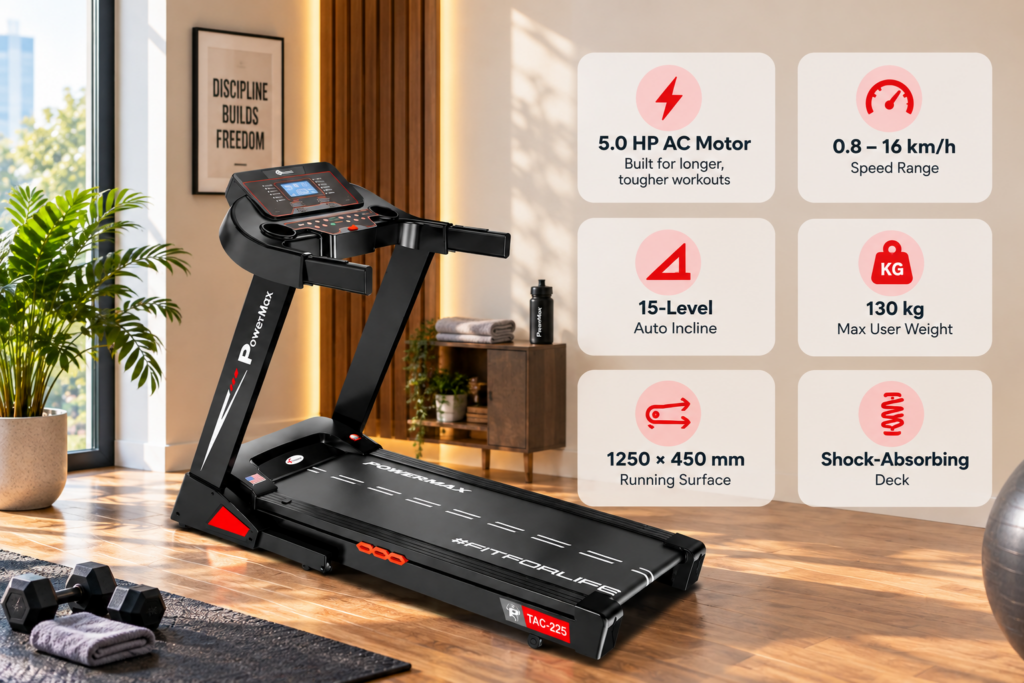
Buying a treadmill when you’re around 100kg, 110kg, 120kg or more isn’t quite as simple as finding a machine with a matching number on the specification sheet. A treadmill rated for 110kg, for example, doesn’t necessarily mean it’s the right choice for a 110kg person who plans to run on it every day. Walking, jogging and running place different demands on the machine, which is why treadmill weight capacity needs to be considered alongside the motor, running surface, cushioning and intended workout. PowerMax’s home-use range includes treadmills across the 110kg, 120kg, 130kg and 140kg capacity classes, giving you several options depending on how you actually plan to train.
So, if you’re searching for the best PowerMax treadmill for 110kg, 120kg or 140kg users, here’s what you should look at before choosing one.
What Does Maximum User Weight on a Treadmill Actually Mean?
The maximum user weight is the highest weight specified for the treadmill. But it shouldn’t automatically be interpreted as the ideal weight for every type of workout. This is especially relevant when you’re comparing a Treadmill For Home for walking with one that you’ll use for regular jogging or running. PowerMax’s own product guidance gives an example of this distinction. The TDM-97 has a maximum user weight of 110kg, but PowerMax recommends an additional 25kg buffer for running, meaning the running recommendation is lower than its maximum walking capacity. The same principle appears on the UrbanTrek TD-M1. It is rated for a maximum user weight of 120kg, while PowerMax recommends a 25kg buffer for running and gives 95kg or less as an example for that activity. That’s why the right question isn’t simply:
“How much do I weigh?”
It is:
“How much do I weigh, and what am I going to do on the treadmill?”
Best PowerMax Treadmill for a 110kg User
If you’re around 110kg, PowerMax has several home-use treadmills in this capacity class. The current range includes models such as the TDM-95, TDM-96B, TDM-97, TDM-98 and TDA-95. Several of these have 110kg maximum user capacities and running surfaces around 1100 × 400mm. For someone primarily interested in walking or lighter home cardio, a 110kg treadmill can be an option when that use falls within the manufacturer’s recommendations. If you’re planning to jog or run regularly, however, it’s worth considering a higher-capacity treadmill rather than buying one simply because its maximum user weight matches your body weight.
PowerMax TDM-96B for Home Use
The TDM-96B is one of the PowerMax home-use options in the 110kg category. It uses a 4HP DC motor and has a 1100 × 400mm running surface. The model also includes a four-level manual incline, PVC cushion shock absorption, 12 preset programs, Bluetooth connectivity and hydraulic soft-drop folding. For a buyer looking for a home use treadmill around the 110kg capacity class, the TDM-96B gives you a useful example of what to compare: capacity, motor, deck size, cushioning, incline and everyday features rather than capacity alone.
What If You Weigh Around 100kg?
This is where choosing purely by search category can become misleading. Someone weighing 100kg might naturally search for a 100kg treadmill, but if they intend to jog or run, a treadmill with additional capacity can make more sense. PowerMax’s treadmill buying guidance recommends leaving additional capacity above your body weight, particularly for higher-impact workouts. So a 100kg user shouldn’t automatically stop looking at 110kg or 120kg treadmills. The extra capacity can be particularly relevant if running is part of the plan.
Best PowerMax Treadmill for a 120kg User
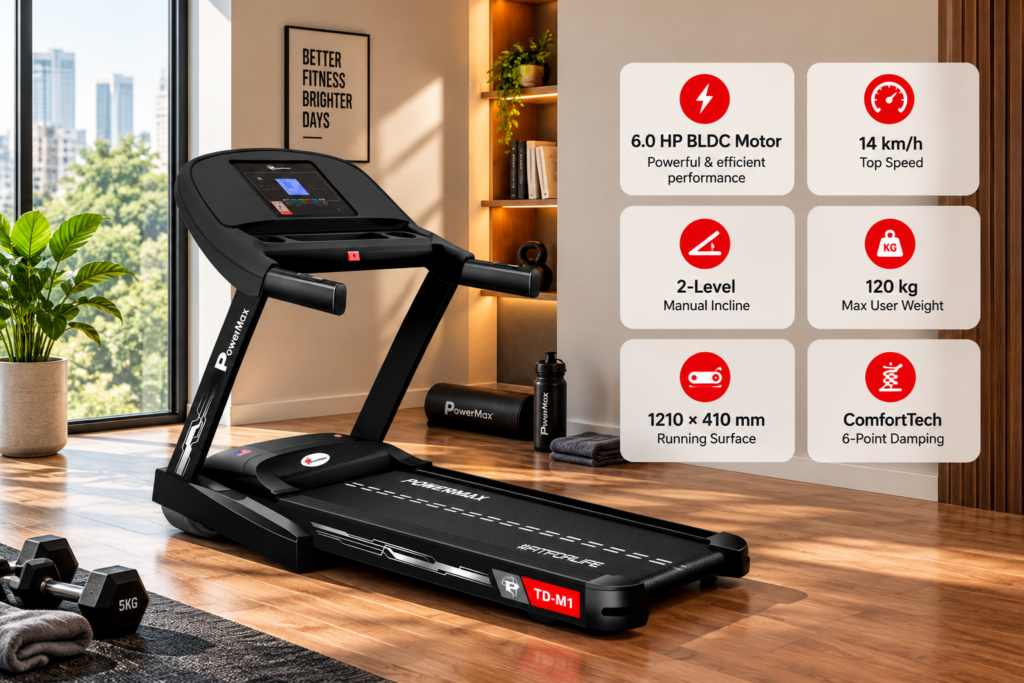
Once you move into the 120kg treadmill category, the running surface and overall construction become even more useful points of comparison. One PowerMax home-use example is the UrbanTrek TD-M1.
It has a 6.0HP HiTorque BLDC motor, 120kg maximum user capacity, 1210 × 410mm running surface, 1-14km/h speed range and two-level manual incline. It also uses ComfortTech 6-point damping with a double-layer running board. The running surface is worth noticing here. A treadmill’s maximum user weight tells you about capacity, but the running deck tells you something about the space you’ll actually have underneath your feet. For taller users or people with a longer stride, that can become just as important. The TD-M1 also includes 12 preset programs, three target-based modes, Bluetooth connectivity and a hydraulic soft-drop folding system. For someone searching for the best treadmill for a 120kg user, these are the specifications worth comparing rather than simply looking for “120kg” on the product title.
Best PowerMax Treadmill for a 140kg User
At around 140kg, the capacity question becomes even more important. PowerMax currently has home-use models in the 140kg category, including the TDA-230 and TDA-230M. The TDA-230M, for example, has a 140kg maximum user weight, 5HP DC motor, 1200 × 420mm running surface, 1-14km/h speed range and 15-level auto incline. It also includes cushion shock absorption, a diamond wave running belt, precision-machined steel-crowned rollers and 12 preset programs. For a 140kg user, don’t just search for a treadmill that says “140kg” and stop there. Look at how the manufacturer defines that capacity for walking, jogging and running.
What About a 130kg User?
The 130kg category is worth mentioning even though it isn’t in the title. That’s because PowerMax has several home-use treadmills rated at 130kg, including the TDM-100M, TDM-125, TDA-100, TDA-125 and TDA-330. For someone around 130kg, this gives you another capacity class to consider rather than jumping directly from 120kg to 140kg. And again, the workout matters. A person looking for a treadmill mainly for walking has different requirements from someone looking for a Running Machine for regular high-speed workouts.
What If You Weigh 150kg?
“Treadmill for 150kg user” is a natural search query, but this is where you need to be careful with maximum user weight.
A treadmill rated at 150kg should not automatically be interpreted as the ideal treadmill for a 150kg user who wants to run. The manufacturer’s stated activity recommendations matter. If you’re around 150kg, check the current PowerMax home-use specifications and usage guidance rather than choosing a treadmill simply because the maximum number matches your body weight.
Don’t Choose a Treadmill by Weight Capacity Alone
Weight capacity is important, but it is only one part of choosing the right Home Fitness Equipment.
Motor
Motor specification matters when you plan to use the treadmill regularly, particularly for jogging and running. Don’t compare horsepower without also looking at the rest of the treadmill’s specifications and intended use.
Running Surface
A larger running surface can provide more room for your stride and movement. For example, the TDM-96B has a 1100 × 400mm running surface, while the UrbanTrek TD-M1 provides 1210 × 410mm. The TDA-230M offers 1200 × 420mm.
Cushioning
If you’re going to spend a lot of time walking or running, the treadmill’s cushioning system is worth looking at. It affects how the deck feels underfoot and how impact is managed during your workout.
Speed
A treadmill for walking doesn’t need to be evaluated in exactly the same way as one you’re buying for regular running. Check the speed range against the workouts you actually plan to do.
Incline
If incline walking or hill-style workouts are part of your routine, look at the type and range of incline available. The TDM-96B uses manual incline, while the TDA-230M offers 15-level auto incline.
Workout Type
This may be the most overlooked factor. Someone looking for a treadmill for daily walking shouldn’t necessarily shop the same way as someone planning frequent running sessions. Before comparing Treadmill Price, decide what you actually need the treadmill to do. For a broader explanation of how to read specifications such as maximum user weight, motor power and running belt dimensions, PowerMax’s How to Read Fitness Equipment Specs Like a Pro guide is also useful.
Which PowerMax Treadmill Should You Choose?
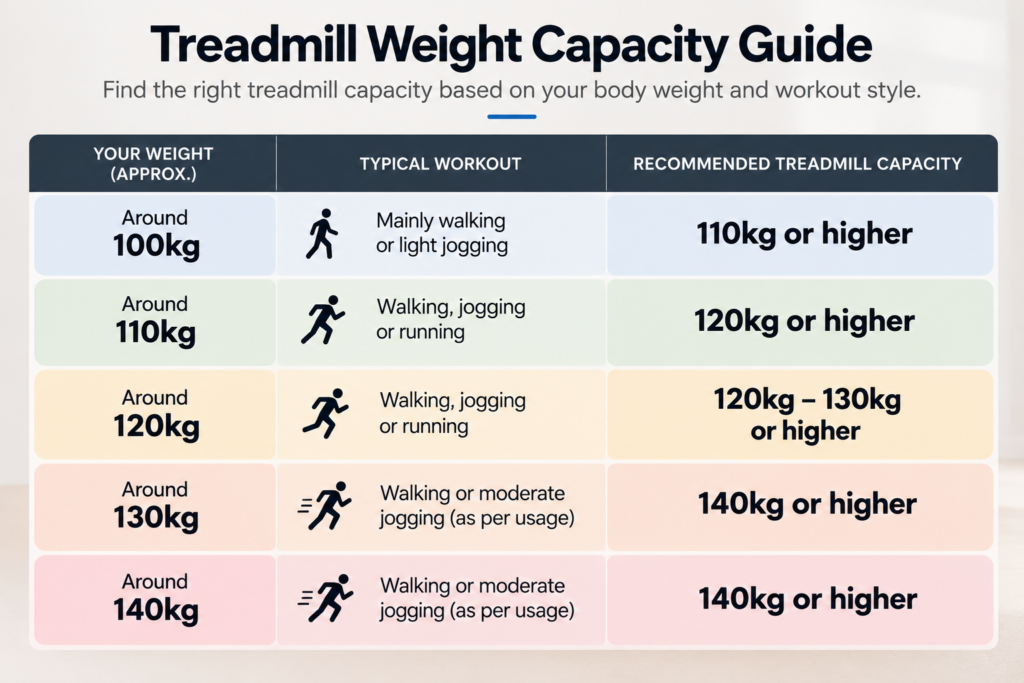
Here’s the simplest way to think about the different weight categories:
| Your approximate weight | What to consider | PowerMax home-use example |
| Around 100kg | Look for capacity above your body weight if you plan to jog or run | 110kg+ models |
| Around 110kg | 110kg models can suit appropriate walking use; consider more capacity for higher-impact workouts | TDM-96B |
| Around 120kg | Look closely at capacity, running surface, cushioning and workout type | UrbanTrek TD-M1 |
| Around 130kg | Compare 130kg and 140kg capacity classes according to your intended workout | PowerMax 130kg models |
| Around 140kg | Pay close attention to the manufacturer’s activity recommendations | TDA-230M |
| Around 150kg | Don’t assume matching maximum capacity means suitability for running | Check current higher-capacity options |
The important word here is “around.” You don’t need to find a treadmill whose maximum user weight exactly matches the number on your weighing scale. You need to consider your weight, your workout and the capacity recommended for that activity.
So, What Is the Best PowerMax Treadmill for Your Weight?
There isn’t one PowerMax treadmill that makes sense for every user. If you’re around 110kg and mainly want a home treadmill for walking, the 110kg category gives you several options, including the TDM-96B. If you’re around 120kg, the UrbanTrek TD-M1 provides a 120kg capacity with a larger running surface and BLDC motor. For users around 140kg, PowerMax’s 140kg home-use range provides higher-capacity options such as the TDA-230M, subject to current availability and the manufacturer’s activity guidance. The smarter way to shop is to look beyond the number.
Your weight tells you where to start. Your workout tells you what capacity and specifications you should actually look for.
FAQs
What is the best treadmill for a 110kg user?
Start with PowerMax’s 110kg home-use treadmills, but consider additional capacity if you plan to jog or run regularly. The TDM-96B is one current PowerMax option in this category.
What is the best treadmill for a 120kg user?
Look at PowerMax’s 120kg home-use options and compare the running surface, motor, cushioning, speed and intended workout. The UrbanTrek TD-M1 is one example, with a 120kg capacity and 1210 × 410mm running surface.
What is the best treadmill for a 140kg user?
PowerMax has 140kg home-use models such as the TDA-230M. However, maximum user weight should not be treated as the recommended running weight without checking the individual product guidance.
Should I buy a treadmill with exactly my body weight capacity?
Not necessarily. If you plan to jog or run, additional capacity can be useful. Always check the manufacturer’s recommendations for your intended activity.
Is a 130kg treadmill suitable for a 120kg user?
It can be, depending on your workout and the treadmill’s other specifications. A higher capacity can provide additional headroom, but motor, running surface, cushioning and speed should also fit your needs.
Can a 100kg person use a 110kg treadmill?
A 110kg treadmill may be appropriate for a 100kg user depending on the intended activity and the manufacturer’s recommendations. For regular running, look at the recommended buffer rather than capacity alone.