Buying a treadmill online can get confusing pretty quickly. You may see one treadmill for ₹15,000, another for ₹30,000 and another for ₹50,000, all promising home workouts, motorised running and plenty of features. So what exactly are you paying for? The treadmill price in India can vary significantly depending on the motor, running surface, user capacity, incline system, cushioning, construction and features. Current Indian listings cover everything from compact walking machines to premium home treadmills costing well above ₹50,000.The better question isn’t simply “How much does a treadmill cost?” It’s “What kind of treadmill can I expect at my budget?” This 2026 guide breaks down the treadmill price range in India, what you generally get at different budgets and how much you may actually need to spend for your type of workout.
How Much Does a Treadmill Cost in India in 2026?
For home use, treadmill prices currently span a very wide range. As a practical buying guide, you can think about the market like this:
| Treadmill Price Range | What You Can Generally Expect |
| Under ₹10,000 | Basic walking pads and entry-level machines |
| ₹10,000-₹20,000 | Budget home treadmills for walking and light workouts |
| ₹20,000-₹30,000 | More capable everyday home-use treadmills |
| ₹30,000-₹50,000 | Better-equipped treadmills for regular home workouts |
| ₹50,000-₹75,000 | Higher-end home treadmills with stronger specifications |
| ₹75,000+ | Premium home-use machines and more specialised equipment |
These aren’t fixed industry categories. There is plenty of overlap between price bands, and a discounted treadmill can move into a completely different budget category overnight.
Treadmill Price Under ₹10,000
At the lowest end of the treadmill price range, you’re mostly looking at compact walking machines, walking pads and very basic treadmills. This budget can make sense if your main goal is simply to walk at home, particularly if space is limited. You should be more careful if you’re looking for a machine for regular jogging or running. At this price, running surface, motor capability and overall construction can become limiting factors. A cheap treadmill isn’t automatically a bad treadmill. It just needs to match the workout you’re actually planning to do.
Best suited for:
- Basic home walking
- Light daily activity
- Small apartments
- Users who prioritise compact storage
- Occasional rather than intensive workouts
If your goal is regular running, it is usually worth looking at the next few price brackets rather than choosing solely on the lowest treadmill price.
Treadmill Price Between ₹10,000 and ₹20,000
This is where the budget starts becoming more interesting for home buyers. You can find entry-level motorised treadmills designed for everyday walking and lighter cardio workouts. The exact specifications vary considerably, so this is where comparing the motor, belt size, speed and user capacity becomes more useful than simply looking at the price. For example, the PowerMax TDM-95 is currently listed at ₹14,999. It has a 4HP DC brushless motor, 110kg maximum user weight, 1-10 km/h speed range, two-level manual incline and a 950 × 385mm running surface. This illustrates an important point about treadmill price in India: you don’t necessarily have to spend ₹30,000 or ₹40,000 just to get a motorised treadmill for home use. But you should know what you’re giving up as the budget comes down, particularly running space, speed range and additional features.
Treadmill Price Between ₹20,000 and ₹30,000
For many home buyers, this is a particularly useful middle ground. You can start finding treadmills with larger running surfaces, higher speed ranges, better cushioning and more convenience features without moving into premium pricing.
The PowerMax TDM-96B, for example, is currently ₹21,999. It has a 4HP DC motor, 110kg maximum user weight, 1-14 km/h speed range, 1100 × 400mm running surface, four-level manual incline, cushioning, Bluetooth connectivity and hydraulic soft-drop folding. At ₹25,499, the PowerMax TDM-97 sits in the same broad price bracket, with a 4HP DC motor, 110kg maximum user weight and 1100 × 400mm running surface. This is why a treadmill under ₹30,000 can be a sensible starting point for someone looking for more than basic walking.
Treadmill Price Between ₹30,000 and ₹50,000
Move into this range and you’re generally looking at more feature-rich home treadmills. The difference isn’t necessarily about adding flashy extras. You may get a more substantial running surface, better cushioning, higher speed capability, more workout programmes, improved convenience features or a stronger overall specification. The PowerMax TDM-98, currently ₹32,744, is one example. It has a 4HP DC motor, 110kg maximum user weight, 1100 × 400mm running surface, three-level manual incline, multiple workout programmes, shock-absorption features and a foldable design. At the upper end of this bracket, the PowerMax TDM-96M is currently ₹48,400. It adds features such as four-level manual incline, Bluetooth app connectivity, 12 preset programmes, a 1050 × 410mm running surface and additional entertainment features. For someone who expects to use a treadmill frequently, this is the point where it makes sense to stop thinking purely in terms of treadmill price and start comparing the complete specification.
Treadmill Price Between ₹50,000 and ₹75,000
This is a higher-end home-use budget. Here, buyers can start looking for treadmills with stronger motors, larger running areas, higher user capacities, more substantial decks and additional workout or convenience features. For example, the PowerMax TDM-100M is currently priced at ₹55,188. It has a 5HP DC motor, 130kg maximum user weight, 1200 × 400mm running surface, three-level manual incline, 12 preset programmes, Bluetooth connectivity and a multifunction massage feature. A budget above ₹50,000 therefore isn’t automatically about buying a treadmill with more buttons. It can make sense when you need a higher user capacity, larger running area or more substantial specification for frequent home workouts.
What Makes One Treadmill Cost More Than Another?
Two treadmills can look surprisingly similar while having very different prices. The main differences usually come down to the hardware and how the treadmill is intended to be used.
Motor
Motor specification is one of the first things buyers notice, but don’t judge a treadmill by the HP number alone. Look at the complete specification alongside the intended workout, speed range and user capacity. A treadmill designed primarily for walking doesn’t need to be judged by exactly the same criteria as one intended for frequent running.
Running Surface
The running surface becomes increasingly important as speed and stride length increase. A compact belt can work well for walking, but runners generally benefit from having more room to move naturally.
User Weight Capacity
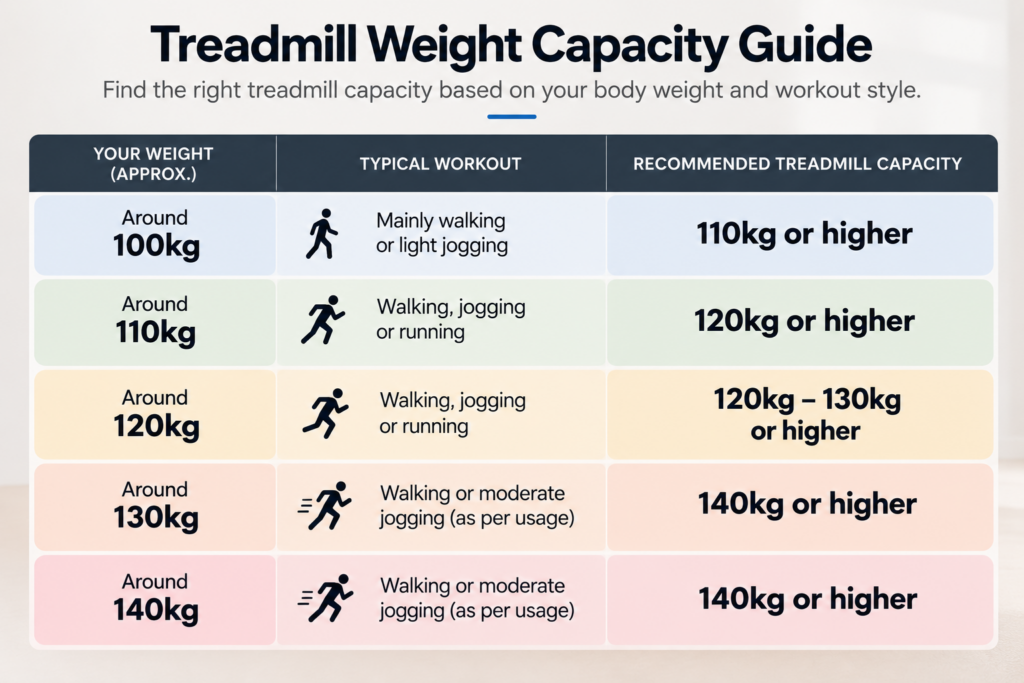
The maximum user weight is another major part of the specification. Don’t treat the published maximum as your ideal target. If you’re planning to run regularly, having some capacity headroom can be useful for stability and long-term use.
Incline
Manual incline and automatic incline are different systems and can affect both the treadmill’s price and the workout experience. If you rarely use incline, there may be little reason to pay significantly more for an advanced incline system.
Cushioning
Better cushioning can make a noticeable difference when you’re walking or running frequently. It’s particularly worth paying attention to if the treadmill will be used for longer sessions or by multiple members of the household.
Build and Construction
Frame strength, deck construction, rollers, belt quality and overall machine design all contribute to the cost. These aren’t features that necessarily look impressive in a product photograph, but they matter when the treadmill is used regularly.
Features and Connectivity
Bluetooth, workout programmes, speakers, app compatibility, display systems and folding mechanisms can all increase the price. The trick is knowing which ones you’ll actually use.
Is a More Expensive Treadmill Always Better?
No. A ₹50,000 treadmill isn’t automatically the right choice for someone who only walks for 30 minutes a day. Likewise, choosing the cheapest treadmill available may not make sense for someone who wants to run several times a week. The best treadmill for home use is the one whose specifications fit your workout. Think about: How often will you use it? Are you walking, jogging or running? How much space do you have? What is the user’s weight? Do you need an incline? How much running surface do you want? Will several people use the treadmill? Answer those questions first. Then look at the price.
How Much Should You Spend on a Treadmill?
There’s no single number that works for everyone. A useful way to think about your budget is:
| Your Main Goal | Sensible Budget Approach |
| Occasional walking | Entry-level |
| Daily walking | ₹10,000-₹20,000+ |
| Walking + regular jogging | ₹20,000-₹30,000+ |
| Regular home running | ₹30,000-₹50,000+ |
| Frequent use / higher user capacity | ₹50,000+ |
These are guidelines, not rules. Someone may find everything they need at ₹20,000, while another buyer may need to spend ₹50,000 or more because of their weight, running requirements, space or desired features.
Treadmill Price vs Features: What Is Actually Worth Paying For?
When comparing a ₹20,000 treadmill with a ₹40,000 treadmill, don’t ask only: “Which one has more features?” Ask: “Which features will actually change my workout?” A larger running surface can be more valuable than a bigger display. A suitable user-weight capacity can matter more than Bluetooth. Good cushioning can be more useful than additional preset programmes. And a treadmill that fits your available space is obviously more useful than one that looks impressive on paper but ends up sitting unused because it is difficult to store. That’s where quality fitness equipment starts to make more sense than simply chasing the lowest price.
PowerMax Treadmill Price Range in 2026
PowerMax’s current home-use treadmill selection covers several price points, which makes it possible to choose according to budget rather than forcing every buyer into the same model. Some current examples include:
| Model | Current Price | Max User Weight |
| TDM-95 | ₹14,999 | 110kg |
| TDM-96B | ₹21,999 | 110kg |
| TDM-97 | ₹25,499 | 110kg |
| TDM-98 | ₹32,744 | 110kg |
| TDM-96M | ₹48,400 | 110kg |
| TDM-100M | ₹55,188 | 130kg |
Current prices and specifications are based on PowerMax’s website and can change with promotions, availability and other commercial factors. The useful takeaway isn’t that one of these is automatically the “best” treadmill. It’s that different budgets can buy very different types of home fitness equipment, and your workout requirements should decide where you sit within that range.
What Is a Good Treadmill Budget for Home Use?
For many buyers, ₹20,000-₹30,000 is a useful starting point for a motorised home treadmill because you can move beyond the most basic machines without immediately entering the higher-end price brackets. If you’re primarily walking, you may be perfectly comfortable spending less. If you want regular running, greater user capacity, a larger running surface or more substantial construction, moving toward ₹30,000-₹50,000 or beyond may make more sense. The right treadmill budget isn’t about spending the most. It’s about spending enough to get the specifications you’ll actually use.
FAQs About Treadmill Price in India
How much does a treadmill cost in India in 2026?
Treadmill prices vary widely. Entry-level walking machines can be found below ₹10,000, while home-use motorised treadmills commonly move through the ₹10,000-₹50,000 range, with premium options costing considerably more.
What is a good treadmill price for home use?
For many home buyers, ₹20,000-₹30,000 is a practical starting range for a motorised treadmill. However, the right budget depends on whether you plan to walk, jog or run and how frequently you’ll use the machine.
Is a ₹20,000 treadmill worth buying?
It can be. A treadmill around ₹20,000 can make sense for regular home walking and lighter cardio, provided its motor, running surface and user capacity match your requirements.
Should I buy a treadmill for under ₹20,000 or ₹30,000?
If your main goal is walking, under ₹20,000 may be enough. If you want more running space, a higher speed range, incline or additional features, moving toward ₹30,000 can give you more options.
What affects treadmill price in India?
Motor specification, running surface, user capacity, incline, cushioning, frame and deck construction, programmes, connectivity, folding mechanisms and warranty/service can all influence treadmill price.
Are expensive treadmills always better?
No. A more expensive treadmill may have specifications you don’t need. The best choice depends on your workout, body weight, available space, frequency of use and desired features.
What is the difference between a ₹20,000 and ₹50,000 treadmill?
The difference can include running surface, motor specification, user capacity, cushioning, incline, construction and convenience features. However, there is no universal rule that every ₹50,000 treadmill is better than every ₹20,000 treadmill.
How much should I spend on a treadmill for running?
Regular runners should look beyond price and pay particular attention to the running surface, speed range, user capacity, cushioning, motor and overall construction. For many home runners, starting around ₹30,000-₹50,000 gives more options, but individual requirements vary.
Final Word
The treadmill price in India has become broad enough that there’s no longer a single “normal” price for a home treadmill. You can spend under ₹20,000 for a basic machine, move toward ₹30,000 for a more capable everyday treadmill, or spend ₹50,000+ when you need higher specifications and more features. The smartest approach is to work backwards from your workout. Walking? Don’t overspend. Regular jogging? Look for a better combination of motor, belt and cushioning. Frequent running or higher user weight? Give greater priority to capacity, running surface and construction.